• Home
  • Blog
  • Media
  • Contact Me
  • Newsletter
  • Bowlings Abroad
  • Nerd Farmer Podcast
  • Teaching Civil Liberties
  • Supporting Undocumented Students
Menu

Nate Bowling: American Teacher Abroad

Street Address
City, State, Zip
Phone Number

Your Custom Text Here

Nate Bowling: American Teacher Abroad

  • Home
  • Blog
  • Media
  • Contact Me
  • Newsletter
  • Bowlings Abroad
  • Nerd Farmer Podcast
  • Teaching Civil Liberties
  • Supporting Undocumented Students

Breaking Up with Google Search

June 2, 2026 Nathan Bowling
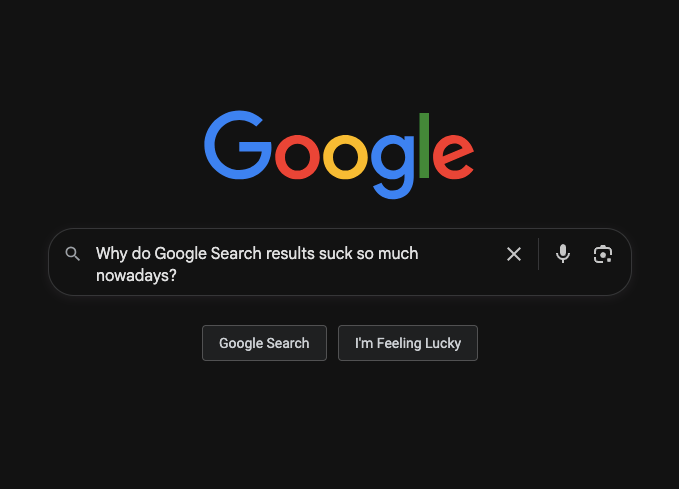
A Google Search window with the question: "Why do Google Search results suck so much nowadays?"

In June 2025, I recorded a conversation with Bill Fitzgerald about artificial intelligence. I ended up getting an earful from him about immorality within Big Tech and some of the aspiring oligarchs within the so-called “ed tech” realm. 

That discussion stuck with me. 

Bill drove home that AI is a form of surveillance. If you use ChatGPT or a similar LLM frequently, go into its settings and check its “memories” and see what it has retained on you. Then check the terms of service or EULA. What terms have they set around data retention?  Who can they sell or share your data with? What’s their policy around warrantless law enforcement data requests?

In some ways, that episode was a continuation of a conversation I've been having about AI and online privacy for over seven years. One of the final episodes of the podcast I recorded before moving overseas in 2019 was called Mommy, My Teacher Got Replaced by a Robot. In that interview and subsequent ones, I’ve noted the non-consensual nature of AI deployment. The major tech companies are hell bent on integrating AI into places where no one has asked for it and then retaining all the data from all the interactions you have with the models.

People aren’t asking for this. 

Specifically, when it came to AI in my day-to-day, I was bothered by the declining quality of Google's Search results and the insertion of AI slop into my queries and finally I had enough (see the example below, bleck!)
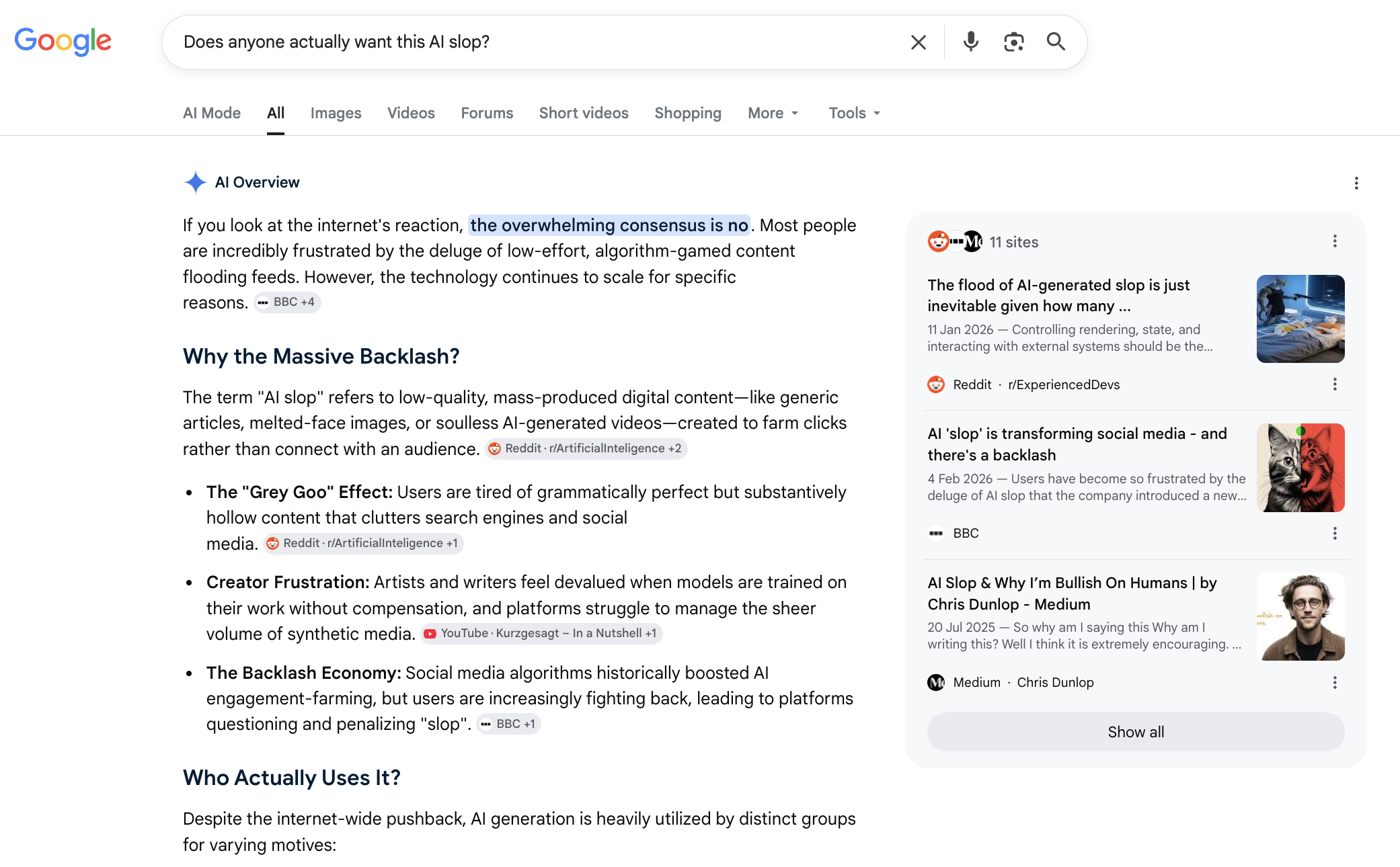
A screenshot from a search of Google asking "Does anyone actually want his AI slop?"

Put up or shut up, those were my choices. In June of 2025, I dropped Google Search and Chrome. I experimented with different browsers and search engines in various combinations trying to find what works best for me. My current set-up is Brave as my browser with DuckDuckGo as my default search engine. I landed on DuckDuckGo only recently (May 2026) after experimenting with some of the options described below.

A bit of context: Google’s Chrome browser is based on Chromium, which is an open source software program. Google adds a proprietary layer on top and packages it as “Chrome.” But since Chromium is open source, anyone can take that foundation and build their own browser — as Brave, Ecosia, DuckDuckGo, and many others have done.
Logo for Brave Browser

Brave is a privacy-focused browser with some rigorous ad and tracker blocking built-in. They have a scorecard when you open the app showing the number of ads & trackers that have been blocked and how much time & data that that’s saved you.
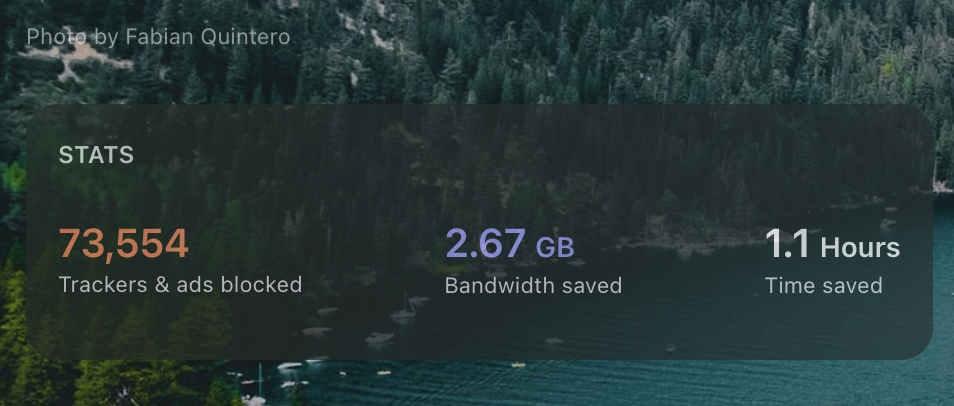
Scoreboard from Brave showing the number trackers & ads blocked along with time and bandwidth saved

Besides the privacy features my favorite feature of Brave is their cross device sync. Most browsers sync through an account you create, usually tied to your email address, and thus your personal info. You sign in, and the company stores (hopefully) encrypted copies of your bookmarks, history, passwords, and settings on its servers. Brave doesn’t require you to create an account. Instead, it uses a system called Sync Chain. When you create a Sync Chain, Brave generates a 25 word sync code, a set of cryptographic keys like a Bitcoin wallet, that allow you to sync across devices.

Brave also makes a search engine that I am less fond of. It’s really not great — but that’s the point. I’m not wedded or hostage to one platform or eco-system, subjected to the whims of its devs and management.
A screenshot of the Ecosia launch page

Ecosia’s offers a search engine and a Chromium based browser. You don’t need to use both, again you can mix & match. They lean into a social-capital gimmick: they pledge to plant trees based on the number of searches conducted. 

Ecosia doesn't run its own search index the way Google does. Instead, it acts as a search layer that gets most of its results from other providers. As of 2026, Ecosia says its search results come from three main sources:

  • Microsoft Bing

  • Google

  • EUSP (European Search Perspective), a joint search index developed by Ecosia and the French search engine Qwant (more on Qwant in moment)

So it’s a do-gooder search engine that searches other search engines, providing you with the results.
A screenshot of the Qwant launch page

Qwant is just a no frills search engine, with no AI integrations and a pledge to keep it that way. Qwant like Brave is privacy focused. It does not create detailed advertising profiles of users and does not track individuals across the web for targeted ads. It also positions itself as a European alternative to Google, an effort to break the continent’s reliance on US tech companies. To me, using Qwant feels how Google Search felt in the 2010s.

I expected some kind of drop-off in search quality when I moved away from Google, but it was the opposite. Google Search has degraded so much over the last few years that it’s nearly useless. The enshittification happened gradually, but it’s obvious to anyone who’s tried to look up something specific lately that Google Search is broken. I don’t remember who said it first, but it’s stuck with me: Google Search now basically operates in one of two modes. If it can serve you a volley of ads based on your query, it will. If it can’t, it hands you AI slop from Gemini.

This is what non-consensual AI deployment looks like. I didn’t ask for these garbage Gemini results, and I didn’t ask for my searches to be flooded with barely readable articles churned out by AI content farms. It is a death spiral for the open internet, and I want no part of it.

I want to be clear here, this isn't some sort of big moral crusade. But we have to start asking ourselves at what point do we start pushing back against the monopolistic practices of big tech and should we really trust them with all the personal, medical, and financial data we do? You’d be shocked what some people put into Chat GPT.

Meaningful regulation isn’t coming in the near term, so it’s up to us to help ourselves.

* A version of this article originally appeared in my newsletter Takes & Typos

In Society Tags AI

I Refuse to Share Space With Neo Nazis and White Supremacists

December 23, 2023 Nathan Bowling

A quick note: For the last year or so, I have written a newsletter on Substack. For a period, I crossposted those here but as the subscriber base for the newsletter grew I stopped doing that. However, due to choices by leadership at Substack, will no longer use the service. However, you can continue to follow the newsletter here.


I don't have a lot of redlines in my life. But one redline I do have is that if an institution or business says that “Nazis are welcome here” I will take my business elsewhere. In the case of Substack, the leadership of the company has made their choice and now I am making mine. It's not a particularly difficult decision. No, this isn't about freedom of speech; no, it's not about censorship. It's simply my choice.

Here is the statement that necessitated my decision from Hamish McKenzie, co-founder of Substack.

I reject the school of thought that the response to people who would wipe me from existence is some sort of constructive debate in the “marketplace of ideas.”

The Nazi Bar analogy is instructive here: if I found out my favorite bar welcomed Nazis, I would stop going to it. If I found out that a social club I belong to welcomed Nazis, I would stop being a member. I shouldn't even have to explain this, but here we are in the year of our Lord 2023, having to have this silly conversation.

“We’re going to keep Nazis and other white supremacists on our platform because we believe that limiting them is censorship” is a stupid, infantile argument. It's so clownish I'm not going to waste my time explaining.

Here is Chat GPT with a simple breakdown:

Denying monetization and access to services for Neo-Nazis and white supremacists is not a violation of free speech because private companies have the right to set and enforce their own content policies (emphasis added). Free speech protections typically apply to government actions, not private entities

Platforms have the authority to establish guidelines to maintain a safe and inclusive environment, and restricting content that promotes hate speech or violence is within their prerogative. This is not censorship in the legal sense, as individuals are still free to express their views elsewhere on different platforms or through other means.

ChatGPT 3.5: December 22nd, 2023

Choosing to carry and monetize the speech of Neo-Nazis and white supremacists is a commerce choice this company has made and it's a choice that I disagree with, and I'm taking my business elsewhere.

Given that, this will be the last edition of the newsletter sent from Substack. I will spend the next 48 hours transitioning to a different service. I'm trying to figure out if I want to use Buttondown or Ghost. If you have thoughts about either platform, shoot me an email. Both services have drawbacks and are more difficult to use than Substack, but that’s the cost of having taste and boundaries.

There will be a regularly scheduled edition of the newsletter on Sunday. I’ll talk a little about the verdict in the Ellis trial and reviewing the books that I read this year. If you follow the newsletter solely via the Substack App you will lose access to it. But you can get it via your regular email inbox by changing a setting in the app.

Again, you can subscribe to the next iteration of the newsletter here.


In Personal, Society

The Case for Banning Phones in School

June 17, 2023 Nathan Bowling

The internet is a pretty awesome tool but like fried foods, bourbon, and salty snacks, too much of a good thing will mess you up - Image by Jawad Ali

I am generally reluctant to embrace “bans” as a solution to a problem. I think the War on Drugs is/was among the gravest injustices of my lifetime. I believe prohibitions on gambling and sports betting are dumb—who cares if someone wants to put 20 bucks on the Timbers to lose. The current book banning spree conservative culture warriors are pushing is gross and ripped straight out mid-twentieth century European history. I thought the recent congressional hearing and talk about banning Tik Tok was a flashing red light on the US’ slide into both state censorship and stupidity. I could go on.

But given all that, I still think I am down with a ban or more precisely a time, place, and manner restriction on adolescent phone use at school. Because smartphones are a fairly recent innovation, we don't have a ton of long-term research on the topic. But what we do know is bad. Here’s the skinny from the National Library of Medicine:

An observational study showed that spending more than a few hours per week using electronic media correlated negatively with self-reported happiness, life satisfaction and self-esteem, whereas time spent on non-screen activities (in-person social interactions, sports or exercise, print media, homework, religious services, working at a paid job) correlated positively with psychological well-being, among adolescents. Other observational studies have linked spending more than 2 hours a day on social networking sites and personal electronic devices with high rates of suicidality and depressive symptoms among adolescent girls, although youth who sustained high levels of face-to-face socializing were relatively protected against the negative consequences of too much time online.

That part about “in-person social interactions” having a positive impact on well-being is essential. Listen, I am not C. Doleres Tucker and this isn’t a screed about banning kids from the internet. Online connectivity, like cured meats, are gifts from on-high. My life would be fundamentally more poor without the internet and without salami. But I wouldn’t try to subsist on a diet of salami, prosciutto, chorizo, and bacon (and if I did, I hope someone would intervene). That’s basically where I am on this topic. Too many students in too many schools have a diet of laptop screen time in class and social media screen time out of it. Schools should be a place where we encourage prosocial behavior and human interaction. Banning phones on campuses would encourage more of that.

You all felt the same way. Here’s a reply from a reader P.C. that is representative of the feedback that was sent:

FWIW, one of the reasons we chose [redacted: description of school], was because they have a pretty decent social media policy—they have a big board with a bunch of pockets hanging by the door, and on the way into the classroom the kids just drop their phones in.

Boom. Easy peasy for the teachers, now, because there's a very absolute no-mobiles policy, and if you see a kid with their phone in their hands (or on their desk or anything) then it's immediately confiscated and sits in the head's office for at least a day or two (he's notoriously slow to contact parents and arrange a pickup... intentionally) before it goes back.

And somehow, breaking that physical connection kind of leads to the kids not being quite so glued to the damn things even OUTSIDE of the classroom.

Reader R.G. added:

 It's for the social-emotional well-being of these kids. My own [redacted info about the gender of RG’s children] get anxiety about having interactions with people when they have business to take care of. We ALL have that anxiety. But because these kids are always on their phones, normal social interactions become HARD because they don't engage with them that often. The more you interact with others, the easier it gets.

Although some folks get squeamish about it, schools are tools and venues of socialization into a culture's norms. The three decisions that I have made that had the biggest impact on my happiness are marrying Hope, taking the plunge to teach overseas, and getting the hell off Twitter. I am still online. Like, obviously I am not writing this on a typewriter like Cormac McCarthy (who sadly we lost this week) but I think getting students off their phones on campus would in the long run have the same positive impact on students.

In Education Tags K-12, smartphones
Comment
Older Posts →

POWERED BY SQUARESPACE