• Home
  • Blog
  • Media
  • Contact Me
  • Newsletter
  • Bowlings Abroad
  • Nerd Farmer Podcast
  • Teaching Civil Liberties
  • Supporting Undocumented Students
Menu

Nate Bowling: American Teacher Abroad

Street Address
City, State, Zip
Phone Number

Your Custom Text Here

Nate Bowling: American Teacher Abroad

  • Home
  • Blog
  • Media
  • Contact Me
  • Newsletter
  • Bowlings Abroad
  • Nerd Farmer Podcast
  • Teaching Civil Liberties
  • Supporting Undocumented Students

My Mom Had to Lie to Get Me Into a Good School

March 4, 2017 Nathan Bowling

Note: This post originally appeared on Education Post. After its publication I was contacted by several of my old teachers from Stanley, the elementary school my mom got me into. I am insanely thankful to Mrs. Anderson, Mrs. Winterhouse, Mrs. Bullock and all the staff from Stanley who taught me then and support and follow my work today. I was also contacted by classmates from Tacoma Montessori, which is how I got my hands on that dope class of '86 photo (Thanks Kati).  

I, like all Black Americans, am keenly aware of the gobsmacking contradictions that come with being Black in America.

Both of my parents fled the South in the 1960s to Washington State, roughly 20 years before I was born. I went through public school during the decline and eventual destruction of federally mandated school desegregation. For six years I proudly served in the U.S. Air Force Reserves, before leaving in 2003 in protest of the Iraq War. For a time, I was vice president of my college Republicans club. I hugged and lifted my teary-eyed mother off the ground, while my friends beat pots and pans in a spontaneous neighborhood parade on election night in 2008. I dabble from time-to-time in respectability politics, but believe vehemently that #BlackLivesMatter.

I am a 37-year-old Black male who teaches American government and politics at a school that is 80 percent students of color in a state that is roughly 80 percent White.

In my classroom, we spend a significant amount of time talking about the gaps between the values we espouse as a nation: liberty, justice, individualism, meritocracy and the reality that we witness on a daily basis: segregated schools, segregated housing, disproportionate law enforcement and sentencing, inequitable school funding, reduced life expectancy and other indicators of systemic racism.

This is the American dilemma: there is no other nation in the world where people who look like me do as well, yet no other nation has such a dogged and continued history of marginalizing and abusing those same folks. Nowhere is this more apparent than in the realm of education.

As a young child, I was blessed to attend a phenomenal, private Montessori school for the early stages of my education. I have clear memories of sign language and Spanish lessons, hands-on science experiments about the physiology of a sunflower, and the shocking experience of seeing the chemical reaction when vinegar and baking soda are mixed for the first time.

I had a predictable routine. Every morning, my mother would drop me off at school on her way to work and every evening my grandmother would come and pick me up. Grandma and I would ride the #27 bus down MLK, past the bank and the local pool, back to her house where she would help me with my letters and numbers…then reading…then, as I aged, homework until my mother could pick me up and take me home for dinner.

This was my routine: mom, Montessori, slippers, learning, copious snacks, grandma, learning, mom, dinner, TV or reading (usually not TV), bed. Wash, rinse and repeat.

At the school, I also recall being one, along with my friend Sterling, of only two Black children. This was a harbinger of what was to come. As my neighborhood, Tacoma’s Hilltop, descended into drug-fueled gang violence in the 1980s, my school closed up shop and moved to whiter pastures, in a nearby suburb. The building remained vacant for years and at one point in my early adulthood, it was turned into a funeral home—a poignant reminder each time I passed by it.

My mother put me in the Montessori because she lacked faith in my neighborhood school. With my Montessori’s closure, my mother, ever resourceful, ever the advocate, went around the system. She lied. She used her church friend, Sister Crawford’s address, to get me enrolled at a school focused on the arts and sciences. I do not believe I would be the man I am—the teacher I am—without her lie.

But, in a nation as wealthy as America, no parent should have to lie about their address to get their child into a high-quality school. Sadly, I have heard this same tale from many, many other Black families. She did the same when it was time for me to go to high school. For my sake, she lied.

I think about this often when I stand before my own classroom today. What would Black parents say about my teaching and the way I treat their children? How do I best make my classroom a place where parents know their children are valued? How do I make my classroom a place where students feel safe and loved? How do I make my classroom instruction relevant to their lives and needs? These are the preconditions for effective teaching and learning. These are questions every educator should ask themselves every day.

As Washington State’s 2016 Teacher of the Year, I visited numerous schools and talked with hundreds of teachers across our state. My lone, lingering frustration from that experience is my anger at walking the halls of a school filled predominately with Brown students and happening on an International Baccalaureate (IB) history class that was Whiter than the Trump cabinet.

It is infuriating, but also painfully common. Students enrolled in Advanced Placement (AP) and IB classes are challenged to do college level work, while in high school, are statistically more likely to go onto college, and more likely be successful there. Denying children of color access to these classes—particularly at majority Brown schools—is an act of callous racial injustice, but also common practice across the country.

It doesn’t have to be this way. Throughout most of my life, the school where I teach was the lowest-performing high school in our district. That’s not the case anymore. We now graduate over 80 percent our students on time, over 45 percent of our kids are enrolled in an AP class. We are at capacity and have a waiting list to get into the school, despite the recent opening of a charter school nearby.

My AP classes are as diverse as the building itself and the neighborhood surrounding it. Last year nine starters from our football team, five of them Black males, passed the AP government exam—all of them are now in college. We’re living, breathing proof of what’s possible when we put our focus on the students.

District leadership has provided additional staffing and funding to our highest need schools. In my school we have a family support specialist—in others there are partnerships focused on keeping families in stable housing. I recently asked my mother, “Would you send me to McCarver [my old neighborhood school] today?” She replied, “Yes, yes I would.” This is a measure of progress we have made.

The fights in education shouldn’t be about models of schooling, but instead about the quality of the educational experience for the students. Kids of color and low-income students deserve great teachers, great schools, access to challenging courses and they shouldn’t have to lie to get them.


In Education, Personal, Society Tags #BlackLivesMatter, Stanley Cougars, Tacoma, EduPost, #Educolor
1 Comment

Trump: My Glass is Half-Empty

November 20, 2016 Nathan Bowling
Trump.jpg

If your Twitter handle begins with “Deplorable” this post probably isn’t for you. If you believe that Confederate iconography represents some mythical, noble, lost-cause heritage, rather than a treasonous, white-supremacist misadventure, you should press Ctrl+W. If you are willing to explain away the rise in racial and religious attacks, especially those targeting students, in the post-election period, please, for both of us, move along.

My parents came from Jim Crow Mississippi and Arkansas. I know the tales of their youth. I am reminded of these stories as I read the news today. The president-elect of the United States has stated his desire to deport the relatives of many of my students. In the post-election period, his supporters have suggested, because of their religion, registering many of my students in a national database. Before the election, the president-elect said that half of my students deserve to have their bodies violated, if it suits a powerful man’s whim. During a debate, the president-elect said to a quarter of my students, that the path to racial reconciliation in America was through “stop & frisk” and more aggressive law enforcement in black communities. This is opposite of progress.

This isn’t a partisan take. I have voted Republican before. I voted for two Republicans this fall. The Trump administration, his proposed policies, his juvenile temperament, all represent an existential threat to the America that I love—and that I served for six years.

I spent the last two weeks trying to get my head around election night. It fits the historical pattern, but it’s still disconcerting. Every major period of racial progress in America has begat a reactionary retrenchment: Reconstruction saw the rise of the Klan in the South; Johnson’s War on Poverty, Civil Rights Act, and Voting Rights Act preceded Nixon’s landslide victory via the Southern Strategy and dog whistles; now, the first black President, first black First Lady and first two black Attorneys General will be replaced by Donald, Melania, and Jeff Sessions respectively.

The nomination of Jeff Sessions is especially emblematic of the regression that the Trump Administration represents. In 1986, Sessions was nominated for the federal bench by President Reagan, but he was deemed too racist then to be confirmed by the Senate. In the interim, the voters of Alabama have elected him to the US Senate (several times) and he is now a confirmation vote away from becoming the chief law enforcement officer of the nation. I thought we were better than this.

I used my role as 2016 Washington State Teacher of the Year to talk about uncomfortable truths and realities for students of color and students in poverty all over my state. The election hits even closer to home. Many of my students are deeply concerned: Will he deport my mother? My brother has ongoing health issues; will we lose our health care? Will he deny me the right to marry another woman? Will he make me register, since I am a Muslim? These are a few of the questions I have fielded over the last two weeks. Will he? Will he? Will he?

In my government class, we often talk about how the most consequential presidencies are the result of one party rule. Republican rule, Lincoln through Grant, led to three Constitutional Amendments (13-15). Democratic rule gave us The New Deal, Glass-Steagall, AFDC (welfare), and Social Security. Again, Democratic rule, under Johnson brought us the Civil Rights Era. We have handed to Donald J. Trump—the only person ever elected to the presidency without prior governing or military experience—unified government, a Supreme Court nomination, and nearly enough state legislatures under control of his party to amend the US Constitution and cement his policies into our most revered document for generations. We have slept walked into a full blown renegotiation of the social contract—a New New Deal or the Old Deal—if you will.

I can’t look my students in the eye, lie to them and say it’s all going to be okay. I don’t know that it will. We live in dangerous times, particularly for communities of color and those on the economic margins of our nation. In his book “War is a Force that Gives Us Meaning” Chris Hedges described the descent into ethnic cleansing and genocide in post-Soviet Yugoslavia. Data from exit polling shows us we have entered an unprecedented era of tribal voting. Trump won the white vote by larger margins than Ronald Reagan—Ronald-effing-Reagan. The president-elect has a white-nationalist leader working as his senior adviser. Brietbart and Fox News could serve as Eastern Bloc style quasi-state news agencies. Neo-Nazis and leaders of the Klan have heralded his election. The attacks and violence we have seen across the nation echo the early pages of Hedges’ book. I’m not suggesting we are headed down that path to Milosevic, but it is now a non-zero probability.

I have no time for your pleas to “wait and see.” You can keep your false equivalence arguments. I have no interest in any of it. We have entered an age of uncertainty. The sole check on Trump’s authority are the Federal Courts and Congressional Republicans. That thought should send a shiver down your spine.

Throughout US history, teachers (especially black teachers) led struggles for justice: guiding freedman in the transition from the agrarian to the industrial after Emancipation, leading and modeling democratic citizenship in protests during the civil rights movement. My teaching license literally says “Humanities Teacher.” I will not sit idly by while the very humanity of my students is questioned and renegotiated. This is the work ahead.

We must lead.

In Society, Politics, Education Tags Trump, Election 2016
Comment

30 Americans: Having Difficult Conversations through Art

October 29, 2016 Nathan Bowling
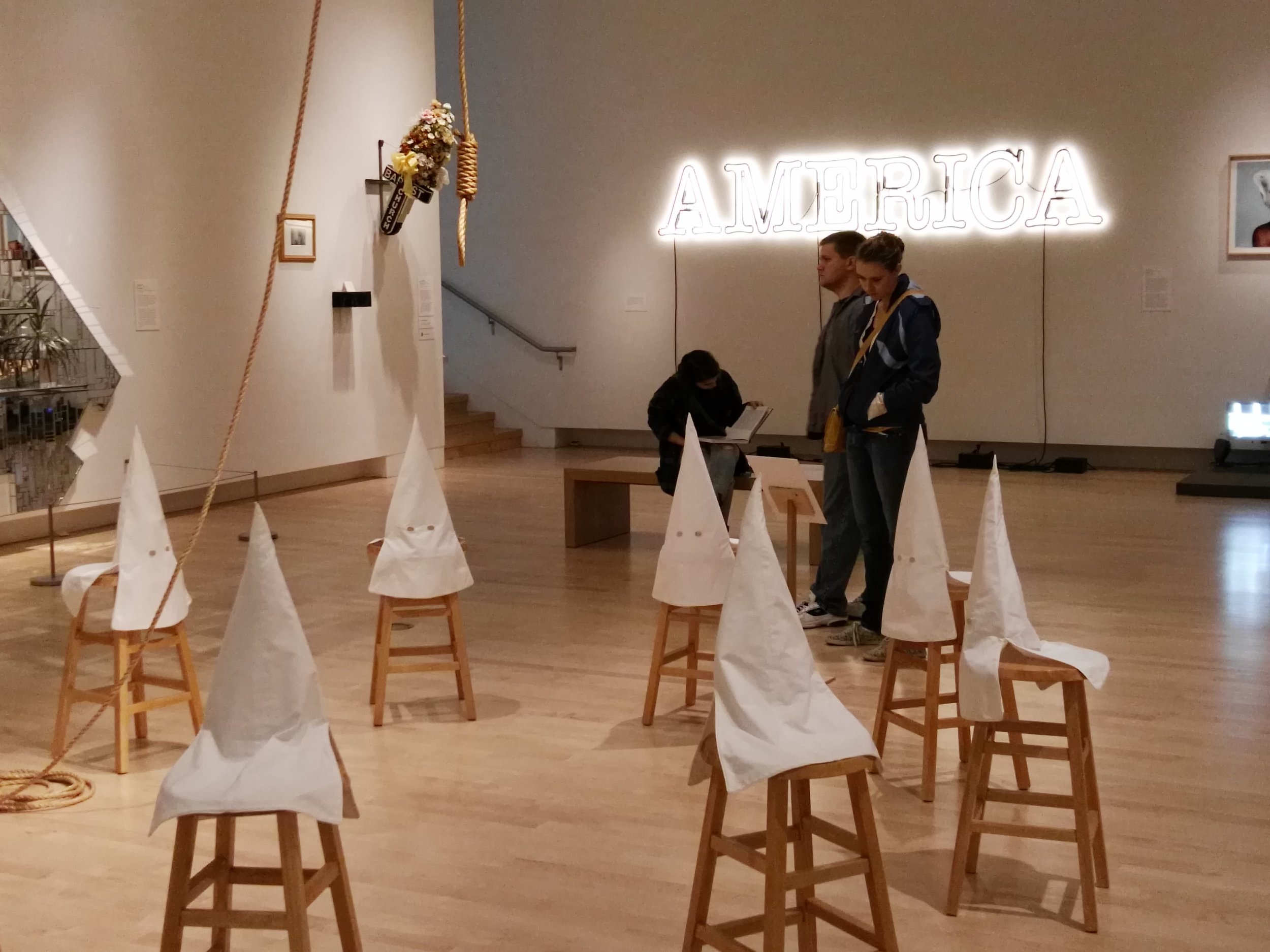
Duck, Duck, Noose

Duck, Duck, Noose

The lowest grade I earned in college was in an art appreciation class. Don’t laugh. It was an evening class; I was a working student. I loved the class, but one evening when the lights went out for the slideshow, my lights went out too. Three weeks later, I bombed the final because I apparently slept through a lecture on Cubism and was helpless on the essay I was supposed to write on Les Demoiselles d'Avignon. I’m still bitter.

As an adult, I’ve grown to  love art and the museum experience. I worked at the Museum of Glass in graduate school. When my spouse I travel we always hit the local museum. I see art as a worthwhile distraction and museums as a sanctum--places to pause and to ponder.

Context matters. Recently, after getting strong recs from several friends, I went to the Tacoma Art Museum to see their 30 Americans Exhibit. In 2015, TAM (rightfully) caught holy hell from the black and progressive communities in Tacoma. TAM curated and hosted a reflection on the history of HIV/AIDS in the US that largely excluded the voices and the experiences of black Americans and artists. Like many social, economic, and health issues communities of color are disproportionately impacted by HIV/AIDS. Their exclusion drew loud, sustained, public (and IMO justified) protests.

There was “die-in” protest, charges the museum was "erasing black people," and several articles in local media outlets called out the museum’s curatorial practices. Christopher Paul Jordan, a local artist and one of my favorite minds in our community was blistering in his criticism. He told the News Tribune “AIDS has absolutely affected art history within black communities. This is beyond negligent. They’re not concerned with (black) stories. … This is not individual racism. It’s about a system within the museum that’s developed a white normativity. It’s a reflection not just of the museum but of Tacoma itself.”

This apparently provoked some introspection at TAM and one result of that introspection is the public programming around 30 Americans. 30 Americans is an exhibition of 30 black artists. To accompany it, TAM is hosting moderated panel discussions, a documentary film screening, a poetry slam, and several “free days” where people can experience the exhibit. The exhibit also has an interactive area where community members can leave their thoughts on pieces or review the feedback of others.

For this exhibit, TAM also reached out to the “old-guard civil rights community” (a conversation for a different day) and created an advisory committee to help with community promotion and engagement. This is a step in the right direction. When I worked at the Museum of Glass in the early aughts, I was often the only person of color--and rarely ever saw another black face--at museum events. A decade & change later, when I walk into the MoG and TAM, it feels much the same way.  Though this exhibit suggests progress, it’s clear that TAM (and the Tacoma museum community writ-large) have a ways to go.

The exhibit itself. I am not an art critic and I’m not going to play one here. That said, here are some pieces that gave me pause or provoked an especially strong emotional response.

Duck, Duck, Noose is the centerpiece of the exhibition and the first thing you see when cresting the ramp from the main lobby. It’s a lot to take in... especially, when seen in juxtaposition to Glenn Ligon’s America, whose glowing presence on the north wall looms ominously over it.

I enjoyed both of these pieces, but appreciate even more what they are saying in concert. America’s racial history is complicated. My mother is from Arkansas; my father was from Mississippi. Their stories and why they left are in my bones. Most people, black and white, would rather not discuss it. But the historical influence of the Klan, particularly here in the Northwest is undeniable. Oregon was founded as a whites-only "racial utopia," the Klan marched through the streets of Bellingham well into the twentieth century, and don’t get me started on the white supremacist movement in Northern Idaho. This is our history. This is our inheritance. This is who we are.

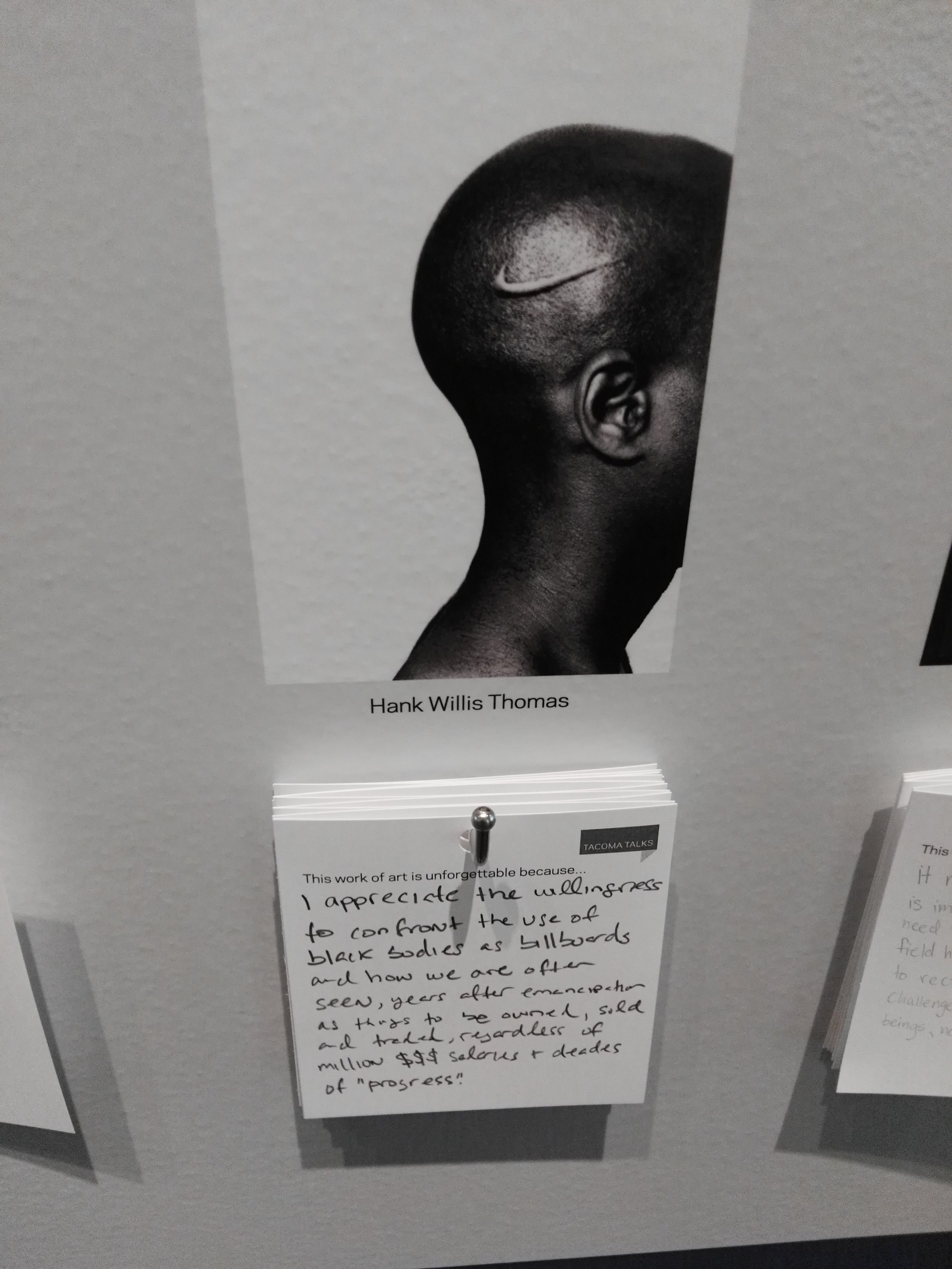
Branded Head speaks to my Olympia, anti-corporate, No Logos, twenty-five year-old self, and I think I would use it as my point of entry in introducing my students to the exhibit. Brand loyalty has always perplexed me, particularly the devotion to shoe companies among the non-athletic. Branded Head is muted and understated. But, it also stayed with me throughout my time in the gallery. This is the reproduction in the section in the gallery set aside for community engagement. You can see my scribbles.

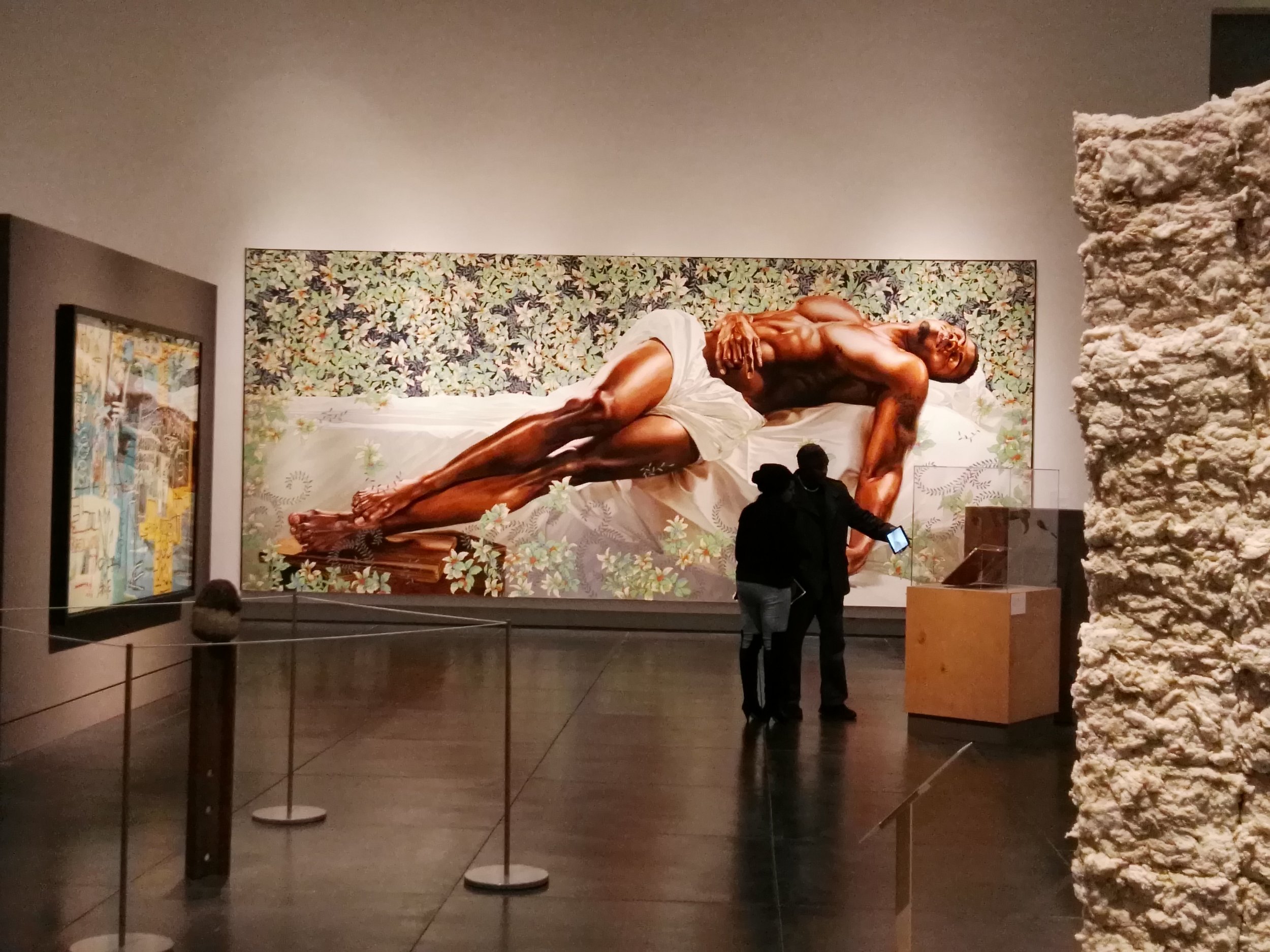
Sleep. When I visited his exhibition at the Seattle Art Museum, earlier this year, Kehinde Wiley immediately became my favorite living painter. Period. His specialty is reframing classic and classically styled paintings by replacing the subjects with black youth. He works on a massive scale. Sleep measures 132” x 300.” Wiley’s work represents a pointed critique of our absence from the art world--the core of last year’s protests--I rarely see people who look me in museums, unless we're working. Wiley’s work is jarring in how bluntly he points out the marginalization of blackness, while simultaneously mocking the odd composition and poses of many classic portraits. Sleep isn’t my favorite Wiley piece, but I think it is very representative of his work and aesthetic.

I have my issues with 30 Americans and you likely will as well. But, that’s talk for tea or cocktails. Its public programming is TAM’s attempt to respond to critics and engage the community. I’m listening, not satisfied, but I'm listening.

Check out the exhibit now through January 15, 2017. If you’ve visited already, I welcome your thoughts and comments below.


In Society, Personal Tags #30Americans, Tacoma Art Museum, TAM, #BlackLivesMatter
Comment
← Newer Posts Older Posts →

POWERED BY SQUARESPACE