• Home
  • Blog
  • Media
  • Contact Me
  • Newsletter
  • Bowlings Abroad
  • Nerd Farmer Podcast
  • Teaching Civil Liberties
  • Supporting Undocumented Students
Menu

Nate Bowling: American Teacher Abroad

Street Address
City, State, Zip
Phone Number

Your Custom Text Here

Nate Bowling: American Teacher Abroad

  • Home
  • Blog
  • Media
  • Contact Me
  • Newsletter
  • Bowlings Abroad
  • Nerd Farmer Podcast
  • Teaching Civil Liberties
  • Supporting Undocumented Students

My Resolution to Talk Like I Teach

January 14, 2017 Nathan Bowling
Photo from Flip the Media

Photo from Flip the Media

I think New Year’s Resolutions are dumb. I thought about joining a gym for about 15 seconds on January 1, but quickly came to my senses. That said, one of the major “learnings” I am taking from 2016 is about the power of the language we use in teaching, politics, and policy. The terms we use, or allow others to use, establish the realm of possibility and the space for policy negotiation.

In my class, I decline to use the loaded political terms like “pro-life” and “pro-choice”. The people who support the death penalty, oppose even modest gun control laws, refuse to condemn excessive use of force by law enforcement, and cheerlead calls to bomb half the nations in South West Asia (I also teach them not to use the Euro-centric nomenclature Middle East) do not deserve to be called “pro-life”. Instead, we use the more accurate and neutral terms "supporters of abortion access” or “supporters of abortion restrictions”.

I think about this often when reading the news. Much of our political discourse happens in terms created by and to benefit those with power and wealth. We unblinkingly use the term “right-to-work” to describe laws designed specifically to weaken unions and their power to collectively bargain. These laws have led to the hollowing out of the middle class and have directly contributed to lower standards of living and wages among “economically anxious” workers in the Rust Belt--the same Rust Belt that Donald Trump swept in the election.

Arguably, the biggest failing of the Obama Administration was conceding to the GOP’s use of the term Obamacare, rather than the Affordable Care Act or ACA. The administration called it Obamacare, the media called in Obamacare, Democratic strategists called it Obamacare, and public approval for the program consistently hovered around 47%. A recent poll showed that approval for Kentucky’s implementation of the ACA is thirty points more popular than “Obamacare” among Kentuckians, even though they’re the exact same thing.

President Obama (unwittingly) allowed a program that provides healthcare to 20 million Americans to become a referendum on him. Now, GOP zeal about repealing the ACA is largely about handing him one final humiliating “L”. All this, even though the individual mandate was originally a Republican policy, even though the program is modeled largely on Massachusetts’ health care program, created by Republican Mitt Romney. They hate Obama, so they hate Obamacare… even if they’re on it. The administration should have seen that coming.

We have to get smarter about the words we choose and how we engage those we seek to persuade. When coastal, college educated, know-it-alls (points finger at self) traffic excessively in jargon we are talking over the heads of folks we need on our side and who share our interests and aspirations.

There are lessons to be learned from the classroom here, dear reader. One of the reasons I am an effective humanities teacher is because I convey complicated ideas in an easily digestible manner; I constantly introduce gestures, create analogies, explain metaphors from pop culture, and on a rare occasion break out a rap. Once understanding is established, I codeswitch to introduce the academic vocabulary for the concept. I teach freshmen about the different types of migration (chain, forced, asylum and labor) by giving historical examples and then assigning each a gesture. Simple language first, then the technical follows.

I plan to keep my classroom in mind this year when talking about education and tax policy. For example, Washington State has the most regressive tax system of any state in the nation. According to The Institute on Taxation and Economic Policy, the poorest 20% of Washingtonians pay 16.8% of their annual income in taxes; for the wealthiest one percent of Washingtonians the number is 2.4%. This creates an unfair burden that harms already struggling low to moderate income families.

Every single person working in the Governor’s office and every member of the Washington State Legislature knows this is true, but for a host of reasons--overly wonky communication by advocates, a slew of corporate campaign spending by opponents, partisan opposition to "all things tax" by one party in the legislature--the sensible solution, one embraced at the federal level, and by 43 states--a progressive income tax is off the table and our schools suffer as a result.

This is at the core of the school funding issues we face in Washington State. But saying our taxes are “overly regressive” is just economic jargon to most. This needs to be put plainly: “If Washington State had Idaho’s tax system (and rates) our schools, mental health and transportation infrastructure would be much better funded.” Y’all, Idaho. This is my begrudging resolution this year--to plain-talk to folks about matters of education, justice and economics that impact my students and my community.

I thought about joining the gym this year, but I think this suits me better.

In Education, Politics Tags avocacy, tax policy, #WAEdu, New Year's Resolution
2 Comments

Trump: My Glass is Half-Empty

November 20, 2016 Nathan Bowling
Trump.jpg

If your Twitter handle begins with “Deplorable” this post probably isn’t for you. If you believe that Confederate iconography represents some mythical, noble, lost-cause heritage, rather than a treasonous, white-supremacist misadventure, you should press Ctrl+W. If you are willing to explain away the rise in racial and religious attacks, especially those targeting students, in the post-election period, please, for both of us, move along.

My parents came from Jim Crow Mississippi and Arkansas. I know the tales of their youth. I am reminded of these stories as I read the news today. The president-elect of the United States has stated his desire to deport the relatives of many of my students. In the post-election period, his supporters have suggested, because of their religion, registering many of my students in a national database. Before the election, the president-elect said that half of my students deserve to have their bodies violated, if it suits a powerful man’s whim. During a debate, the president-elect said to a quarter of my students, that the path to racial reconciliation in America was through “stop & frisk” and more aggressive law enforcement in black communities. This is opposite of progress.

This isn’t a partisan take. I have voted Republican before. I voted for two Republicans this fall. The Trump administration, his proposed policies, his juvenile temperament, all represent an existential threat to the America that I love—and that I served for six years.

I spent the last two weeks trying to get my head around election night. It fits the historical pattern, but it’s still disconcerting. Every major period of racial progress in America has begat a reactionary retrenchment: Reconstruction saw the rise of the Klan in the South; Johnson’s War on Poverty, Civil Rights Act, and Voting Rights Act preceded Nixon’s landslide victory via the Southern Strategy and dog whistles; now, the first black President, first black First Lady and first two black Attorneys General will be replaced by Donald, Melania, and Jeff Sessions respectively.

The nomination of Jeff Sessions is especially emblematic of the regression that the Trump Administration represents. In 1986, Sessions was nominated for the federal bench by President Reagan, but he was deemed too racist then to be confirmed by the Senate. In the interim, the voters of Alabama have elected him to the US Senate (several times) and he is now a confirmation vote away from becoming the chief law enforcement officer of the nation. I thought we were better than this.

I used my role as 2016 Washington State Teacher of the Year to talk about uncomfortable truths and realities for students of color and students in poverty all over my state. The election hits even closer to home. Many of my students are deeply concerned: Will he deport my mother? My brother has ongoing health issues; will we lose our health care? Will he deny me the right to marry another woman? Will he make me register, since I am a Muslim? These are a few of the questions I have fielded over the last two weeks. Will he? Will he? Will he?

In my government class, we often talk about how the most consequential presidencies are the result of one party rule. Republican rule, Lincoln through Grant, led to three Constitutional Amendments (13-15). Democratic rule gave us The New Deal, Glass-Steagall, AFDC (welfare), and Social Security. Again, Democratic rule, under Johnson brought us the Civil Rights Era. We have handed to Donald J. Trump—the only person ever elected to the presidency without prior governing or military experience—unified government, a Supreme Court nomination, and nearly enough state legislatures under control of his party to amend the US Constitution and cement his policies into our most revered document for generations. We have slept walked into a full blown renegotiation of the social contract—a New New Deal or the Old Deal—if you will.

I can’t look my students in the eye, lie to them and say it’s all going to be okay. I don’t know that it will. We live in dangerous times, particularly for communities of color and those on the economic margins of our nation. In his book “War is a Force that Gives Us Meaning” Chris Hedges described the descent into ethnic cleansing and genocide in post-Soviet Yugoslavia. Data from exit polling shows us we have entered an unprecedented era of tribal voting. Trump won the white vote by larger margins than Ronald Reagan—Ronald-effing-Reagan. The president-elect has a white-nationalist leader working as his senior adviser. Brietbart and Fox News could serve as Eastern Bloc style quasi-state news agencies. Neo-Nazis and leaders of the Klan have heralded his election. The attacks and violence we have seen across the nation echo the early pages of Hedges’ book. I’m not suggesting we are headed down that path to Milosevic, but it is now a non-zero probability.

I have no time for your pleas to “wait and see.” You can keep your false equivalence arguments. I have no interest in any of it. We have entered an age of uncertainty. The sole check on Trump’s authority are the Federal Courts and Congressional Republicans. That thought should send a shiver down your spine.

Throughout US history, teachers (especially black teachers) led struggles for justice: guiding freedman in the transition from the agrarian to the industrial after Emancipation, leading and modeling democratic citizenship in protests during the civil rights movement. My teaching license literally says “Humanities Teacher.” I will not sit idly by while the very humanity of my students is questioned and renegotiated. This is the work ahead.

We must lead.

In Society, Politics, Education Tags Trump, Election 2016
Comment

30 Americans: Having Difficult Conversations through Art

October 29, 2016 Nathan Bowling
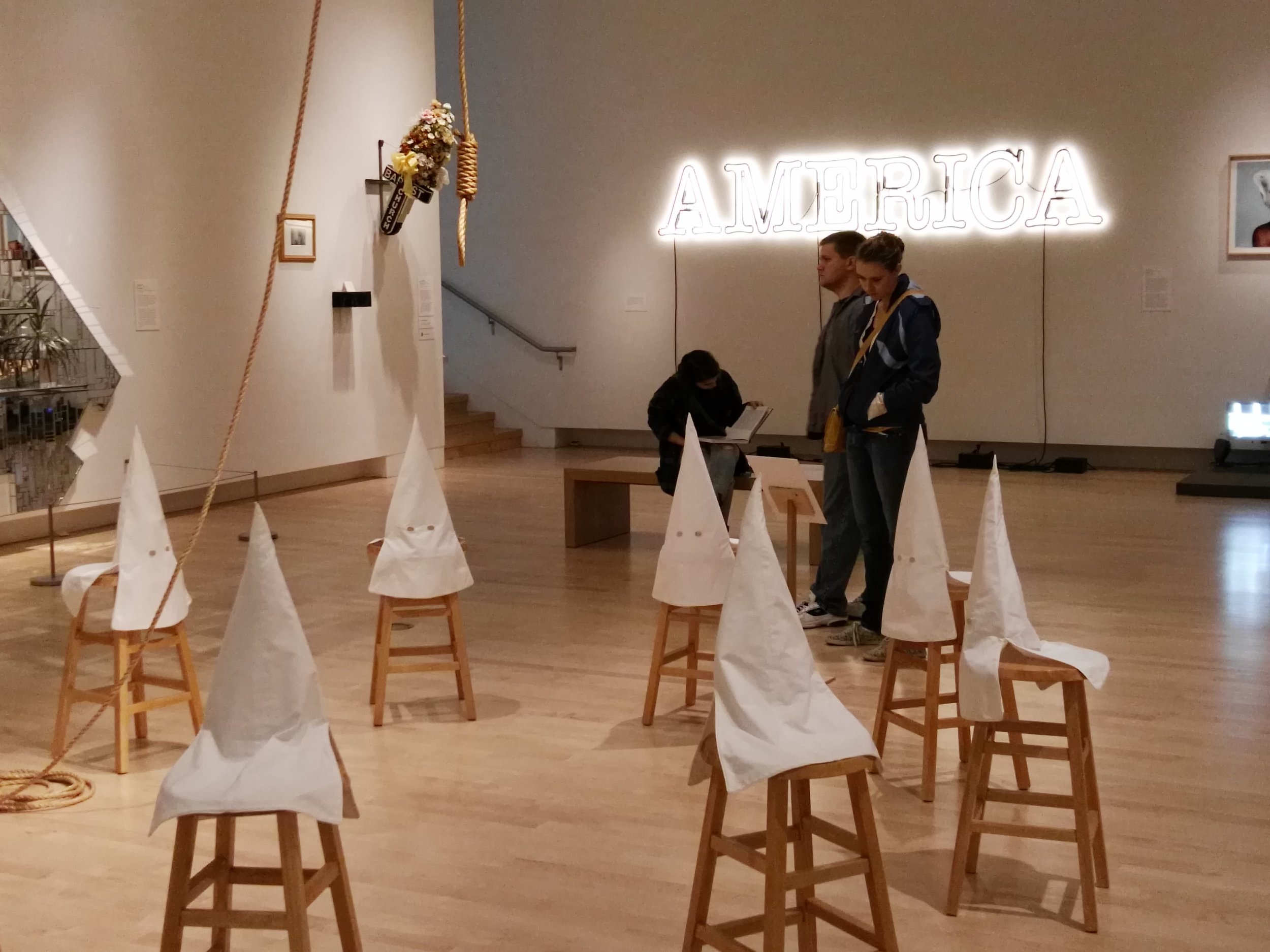
Duck, Duck, Noose

Duck, Duck, Noose

The lowest grade I earned in college was in an art appreciation class. Don’t laugh. It was an evening class; I was a working student. I loved the class, but one evening when the lights went out for the slideshow, my lights went out too. Three weeks later, I bombed the final because I apparently slept through a lecture on Cubism and was helpless on the essay I was supposed to write on Les Demoiselles d'Avignon. I’m still bitter.

As an adult, I’ve grown to  love art and the museum experience. I worked at the Museum of Glass in graduate school. When my spouse I travel we always hit the local museum. I see art as a worthwhile distraction and museums as a sanctum--places to pause and to ponder.

Context matters. Recently, after getting strong recs from several friends, I went to the Tacoma Art Museum to see their 30 Americans Exhibit. In 2015, TAM (rightfully) caught holy hell from the black and progressive communities in Tacoma. TAM curated and hosted a reflection on the history of HIV/AIDS in the US that largely excluded the voices and the experiences of black Americans and artists. Like many social, economic, and health issues communities of color are disproportionately impacted by HIV/AIDS. Their exclusion drew loud, sustained, public (and IMO justified) protests.

There was “die-in” protest, charges the museum was "erasing black people," and several articles in local media outlets called out the museum’s curatorial practices. Christopher Paul Jordan, a local artist and one of my favorite minds in our community was blistering in his criticism. He told the News Tribune “AIDS has absolutely affected art history within black communities. This is beyond negligent. They’re not concerned with (black) stories. … This is not individual racism. It’s about a system within the museum that’s developed a white normativity. It’s a reflection not just of the museum but of Tacoma itself.”

This apparently provoked some introspection at TAM and one result of that introspection is the public programming around 30 Americans. 30 Americans is an exhibition of 30 black artists. To accompany it, TAM is hosting moderated panel discussions, a documentary film screening, a poetry slam, and several “free days” where people can experience the exhibit. The exhibit also has an interactive area where community members can leave their thoughts on pieces or review the feedback of others.

For this exhibit, TAM also reached out to the “old-guard civil rights community” (a conversation for a different day) and created an advisory committee to help with community promotion and engagement. This is a step in the right direction. When I worked at the Museum of Glass in the early aughts, I was often the only person of color--and rarely ever saw another black face--at museum events. A decade & change later, when I walk into the MoG and TAM, it feels much the same way.  Though this exhibit suggests progress, it’s clear that TAM (and the Tacoma museum community writ-large) have a ways to go.

The exhibit itself. I am not an art critic and I’m not going to play one here. That said, here are some pieces that gave me pause or provoked an especially strong emotional response.

Duck, Duck, Noose is the centerpiece of the exhibition and the first thing you see when cresting the ramp from the main lobby. It’s a lot to take in... especially, when seen in juxtaposition to Glenn Ligon’s America, whose glowing presence on the north wall looms ominously over it.

I enjoyed both of these pieces, but appreciate even more what they are saying in concert. America’s racial history is complicated. My mother is from Arkansas; my father was from Mississippi. Their stories and why they left are in my bones. Most people, black and white, would rather not discuss it. But the historical influence of the Klan, particularly here in the Northwest is undeniable. Oregon was founded as a whites-only "racial utopia," the Klan marched through the streets of Bellingham well into the twentieth century, and don’t get me started on the white supremacist movement in Northern Idaho. This is our history. This is our inheritance. This is who we are.

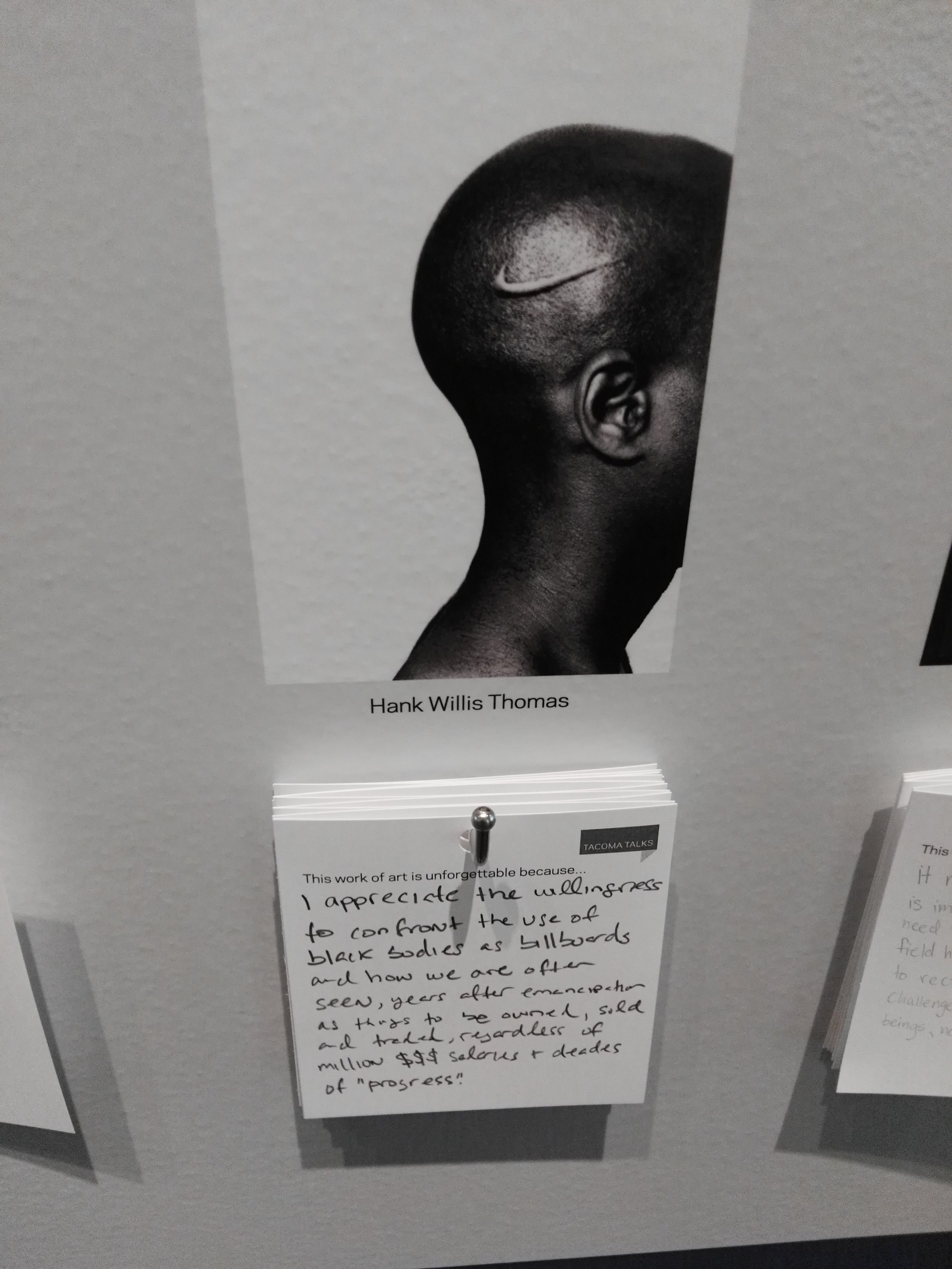
Branded Head speaks to my Olympia, anti-corporate, No Logos, twenty-five year-old self, and I think I would use it as my point of entry in introducing my students to the exhibit. Brand loyalty has always perplexed me, particularly the devotion to shoe companies among the non-athletic. Branded Head is muted and understated. But, it also stayed with me throughout my time in the gallery. This is the reproduction in the section in the gallery set aside for community engagement. You can see my scribbles.

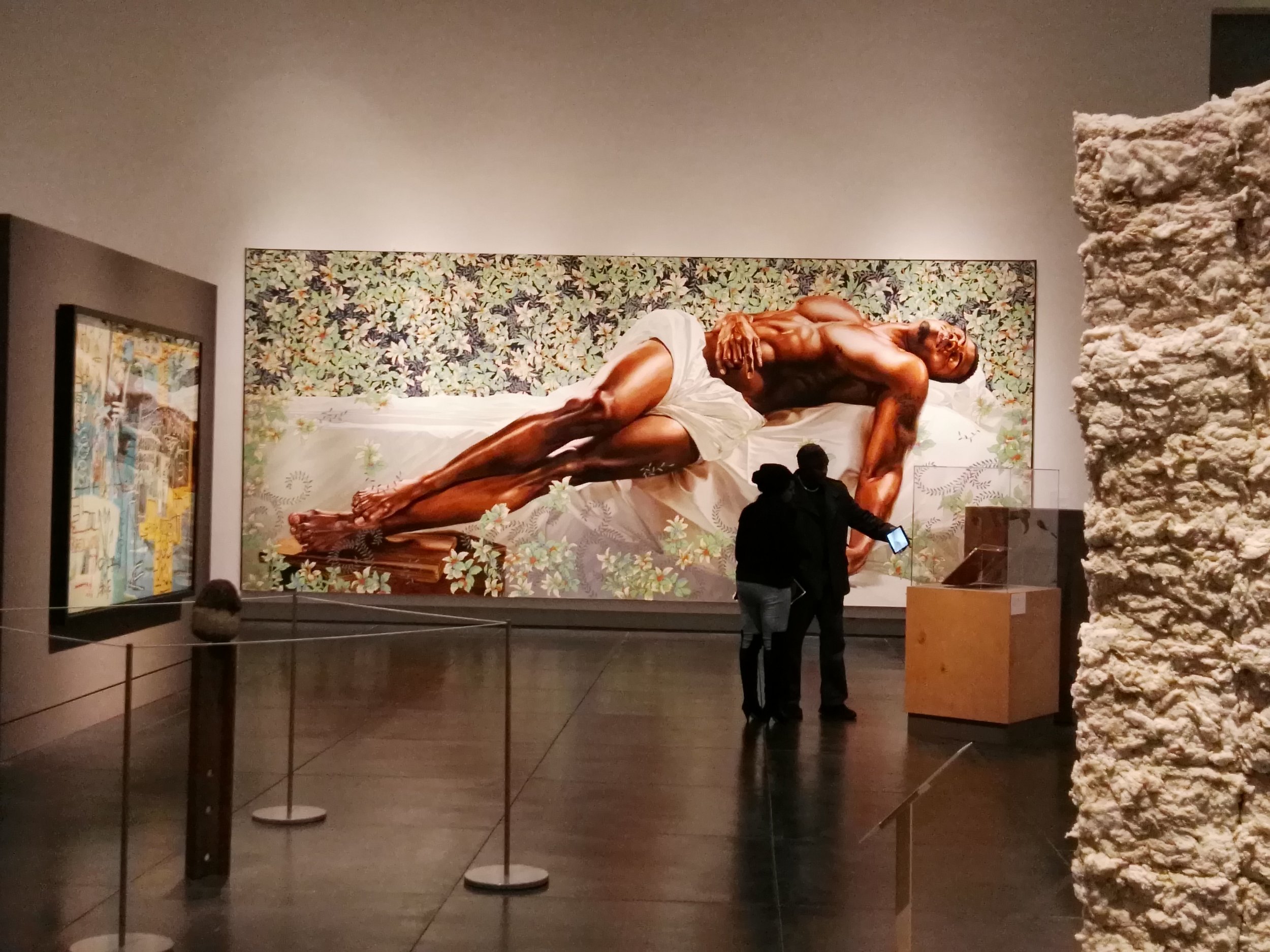
Sleep. When I visited his exhibition at the Seattle Art Museum, earlier this year, Kehinde Wiley immediately became my favorite living painter. Period. His specialty is reframing classic and classically styled paintings by replacing the subjects with black youth. He works on a massive scale. Sleep measures 132” x 300.” Wiley’s work represents a pointed critique of our absence from the art world--the core of last year’s protests--I rarely see people who look me in museums, unless we're working. Wiley’s work is jarring in how bluntly he points out the marginalization of blackness, while simultaneously mocking the odd composition and poses of many classic portraits. Sleep isn’t my favorite Wiley piece, but I think it is very representative of his work and aesthetic.

I have my issues with 30 Americans and you likely will as well. But, that’s talk for tea or cocktails. Its public programming is TAM’s attempt to respond to critics and engage the community. I’m listening, not satisfied, but I'm listening.

Check out the exhibit now through January 15, 2017. If you’ve visited already, I welcome your thoughts and comments below.


In Society, Personal Tags #30Americans, Tacoma Art Museum, TAM, #BlackLivesMatter
Comment
← Newer Posts Older Posts →

POWERED BY SQUARESPACE