• Home
  • Blog
  • Media
  • Contact Me
  • Newsletter
  • Bowlings Abroad
  • Nerd Farmer Podcast
  • Teaching Civil Liberties
  • Supporting Undocumented Students
Menu

Nate Bowling: American Teacher Abroad

Street Address
City, State, Zip
Phone Number

Your Custom Text Here

Nate Bowling: American Teacher Abroad

  • Home
  • Blog
  • Media
  • Contact Me
  • Newsletter
  • Bowlings Abroad
  • Nerd Farmer Podcast
  • Teaching Civil Liberties
  • Supporting Undocumented Students

Rethinking Social Studies for an Uncertain (Likely Dystopian) Future

October 24, 2019 Nathan Bowling
Photo via Pexels

Photo via Pexels

With depressing regularity, since the start of the 2016 presidential campaign, I've felt a tug to blow-up large chunks of planned lessons¹ because of a morning indictment, Congressional hearing, or some norm-shattering tweet. On the days that I do, I set a timer for ten to fifteen minutes and we talk through the scandal du jour. In these moments, my students are always more engaged. They ask incredibly thoughtful questions and then groan loudly when my timer goes off to end our conversations. 

Each time I say to myself, this is how school is supposed to feel. 

No one asked me, but I believe that in teaching, particularly in Social Studies, we're overdue for a revolution in the skills and dispositions we seek to endow students with. I support the Common Core State Standards and C3 Framework, but you can drive a Kenworth Truck through the gaps they have and replicate in students' collective understanding. Standards are important, but standards are also why nearly every US 11th grader can explain the broad contours of the Industrial Revolution, but they're largely oblivious to the role of labor movements and government regulators in taming its greatest excesses. I think it's worth questioning aloud whether the current skills front and center in most Social Studies classrooms -- reading and note-taking, summarizing, answering multiple guess and short-responses -- will meet students' needs in an uncertain near-future. For the record, I believe the answer is "the hardest of nos."

I've opined previously about my leveraging of controversial police shootings and the lack of meaningful law enforcement oversight to engage students about civil liberties in my Government class. My classroom practice is imperfect, but I enjoy learning and thinking aloud. With that, here are some avenues I intend on pursuing this school year, an instructional to-do list:

Do a better job teaching media literacy. If I ever write a book, there will be a profanity-laced chapter detailing my experience visiting Istanbul last week, during the flare-up between the Turkish Military and the Kurds. Seeing events unfold first-hand was my 2,000th recent reminder that we have to do better with teaching students about navigating media.

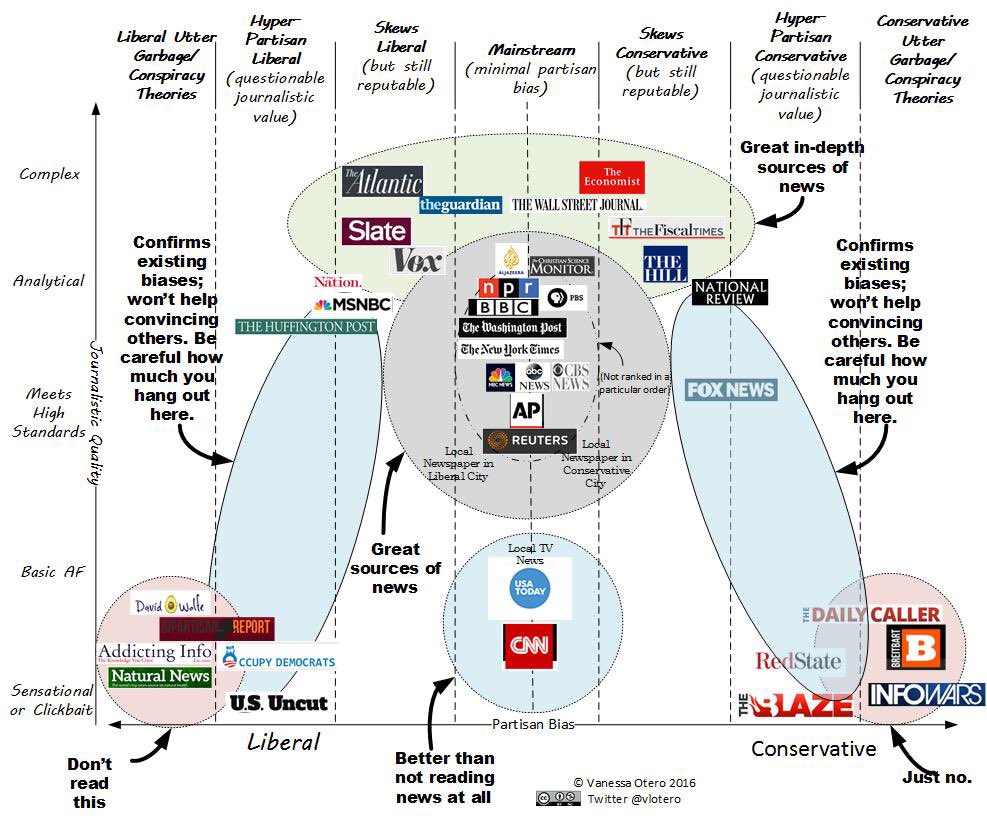
Here's a recent example, below are two widely used graphics about media sources. One is imperfect, the other is arguably educational malpractice. If students are emerging from our classrooms believing that Vox and Breitbart are just "presenting opposing viewpoints" or worse "equally reliable," we're doing them a grave disservice in the name of "objectivity" and that's a terribly bad look.

Created by @vlotero, follow them on Twitter and use this

Created by @vlotero, follow them on Twitter and use this

Never, ever let me see you put this in front of students

Never, ever let me see you put this in front of students

Emphasize the importance of local activism. Trump isn't why US cities are increasingly unaffordable to live in; he's not why people in Washington State can vote at home in their jammies, while black folks in Georgia stand in line for hours; the President isn't why low-income black and brown students attend increasingly segregated and decreasingly equipped and funded schools. These are outcomes of local governments. But how much time do we spend intentionally teaching about school boards, city councils, and state legislatures? Small groups of organized people, especially young people, can make a meaningful impact on local issues and campaigns. But they don't know that if we don't teach them and show them replicable local examples.

Modernize and contextualize teaching about the mid-twentieth century. The civil rights narrative you likely received in school was something like this: "the US was founded, there was slavery, it was bad. Then Lincoln freed the slaves and they were happy. But the South was still mean, but MLK came along and had a Dream and now we're all equal." Similarly, we essentialize World War II and the Holocaust: "Hitler was bad. He tried to exterminate European Jews, but the US Army won the war and freed them." We owe students better. Students need to understand the history of state repression in the US and the rise of fascism elsewhere. We need to mine recent history for lessons for today: Why was the civil rights movement successful? What are some unresolved civil rights issues? How can we apply our understanding of the civil rights movement to issues facing disabled people and the LGBQT+ population? Similarly with World War II: How did Hitler come to power? What institutional or societal checks failed and allowed his rise? How do we prevent violent authoritarianism in modern times? How can we effectively respond to modern fascist movements in the US and elsewhere?

I could go on². These are the kind of questions students should be grappling with and interrogating in class. 

Let's be real. Teaching Social Studies and living in 2019 is really weird. This historical moment demands more responsive models of teaching where we teach students about our complex world (our assigned task). But we also must teach them how to navigate what will certainly be an uncertain near-future (what they will really need). We're already leaving them with crumbling infrastructure, a warming planet, and mounting national debt. The least we can do is give students the skill-set necessary to navigate the (bleak) future we're leaving them.

--

¹ I currently teach AP Government & Politics (college-level civics) and Global Studies (a survey of history, geography, and economics) at an International School 

² Actually, I did on a recent episode of my podcast

This post originally appeared on the blog of the National Network of the State Teachers of the Year

In Education Tags Social Studies, Media Literacy
1 Comment

A Desert Dispatch: the Road to Abu Dhabi

September 28, 2019 Nathan Bowling
Each pin is where one of my students calls “home”

Each pin is where one of my students calls “home”

I was on a very crowded bus in rural Thailand transiting between Surin Beach and Ao Nang. It was July 2018. My wife Hope and I are travelers; we have made summer sojourns to 6 continents and over twenty countries throughout our teaching careers. That day, we were on a long, hot bus ride. We always pick cheap transit and sometimes we regret it. I was sweatily DM-ing my boys Zach Powers and Dave back home about NBA free-agency from the back row of the bus. At a stop along the road, a dozen Thai middle schoolers jumped on board. The young boys were wearing ties and blazers, the girls, dresses and their hijabs. From their uniforms, I assumed they were going to a British School. I turned to my wife and whispered, “Yo, I would teach the s**t out of them.” We both laughed. 

About two weeks later we were in Kuala Lumpur, the bustling Malaysian Capital. On a crowded train heading back from a Buddhist shrine, I turned to Hope again and said, “I want to live here.” Something about it just felt right: safe, English-speaking, good infrastructure, real cultural diversity. Thus began our odyssey into the world of international teaching and our eventual arrival this summer in Abu Dhabi in the United Arab Emirates.   

I’ve opined before about the liberating feeling I get from being abroad. Being black in America is often… complicated. When you get distance from home it brings these complications into sharp focus. Sometimes it’s jarring: In 2015, we taught in a summer program in China. We were watching CTV (Chinese State TV) with our host family and the evening news led off with the murder of Samuel DuBose, by a University of Cincinnati campus police officer. I was speechless. In 2017, after getting battered by a tropical storm and binge-watching Season 1 of Ozark in Mexico, we watched Charlottesville unfold and saw the nation collectively shrug-off the violent, Klan-fueled white supremacy on display. I was saddened. In 2018, while riding in a taxi to the Killing Fields Museum in Phnom Penh. I received a half-dozen texts from back home about my hometown newspaper; the editorial board published a piece equivocating between white supremacists the everyday community activists, like myself, that oppose them. I was enraged. Obviously, none of these are why we left the US, but being away from home gives you distance and a different perspective. 

Fast forward to August 13th of this year. Hope and I boarded an Etihad flight bound for Abu Dhabi with a one-way ticket and basically a full-reboot of our careers in front of us. We’re now immigrants (I prefer that term over ex-pats). I’m teaching AP US Government & Politics and Global Studies at the American Community School. My students, 60% of whom are US citizens, are fascinating. The range of skills in the room is comparable to my students, back home but the range of life experience is not. I have several students who identify with complicated hyphenated backgrounds that I’ve never encountered (or even contemplated) back home: Haitian-Sudanese, Palestinian-Jordanian-Canadian, Uzbek-Texan, Italian-Iranian-American, and because of the presence of the oil industry, there’s a surprising number of kids who call Alaska home. 

There are some obvious differences. School starts at eight and I have longer classes because of our A/B schedule. I have a better sense of work-life balance. I am less tired at the end of the day and at the end of the week. I have more manageable class sizes, my largest classes are in the low 20s, and more time for planning helps me take less work home. My students have access to technology. They have access to delicious, nutritious food before school, during breaks, and at lunch. These seem like little things, but they make a world of difference for students. None of it is rocket science, every student in the US could have these things—we choose not to provide them.

The Dhabs at night, photo by Kevin Ponce Villaruz

The Dhabs at night, photo by Kevin Ponce Villaruz

My life feels less hectic now. We live in a high-rise in a dense urban village called Khalidaya. I can see the Corniche, the most famous beach in the Gulf, from our balcony. We’re surrounded by over a dozen restaurants and three grocery stores within a three-block radius. We walk to and from school each day, often passing and chatting with students. It’s an urban planner's dream. 

This is our life for now and for at least the next twenty-two months, this will be our home. 

Post-Script: If you’re a fan of the podcast the first #BowlingsAbroad episode of my Nerd Farmer show will be recorded this week. Keep an eye on your pod-catcher of choice. 


In Education, Travel

Our Departure and a New Chapter

April 9, 2019 Nathan Bowling
overhead-projector.jpg

I was twenty-seven when I started teaching. George W. Bush was the President, I had hair, and the Mariners playoff drought was only five years-long. I've been doing this long enough that when I started I had an overhead projector with a jar full of Vis-a-Vis markers in my classroom.

Teaching is my profession and I love its moments: first days, conferences, graduation, the staff meet-up after Homecoming. When I got into teaching, my goal was to have a positive impact on my community. To help create better, smarter students as well as neighbors. This is the origin the “Nerd Farmer” moniker.

I'm a grump, but I'm an idealist. When I co-founded Teachers United in 2011, one of the criticisms of the organization was that we were a gaggle of newbie, idealistic, pie-in-the sky teachers. I remember one commenter on an early Seattle Times op-ed I penned saying, “let’s see what you think when you’ve been in a classroom for a while.” The implication was that we would lose our idealism and passion for equity and justice. Well, here we are, bub.

This is my thirteenth year in the classroom. I’m proud of my work as a teacher. I think I've made an impact on my students and the city. For the last several years people have constantly (and annoyingly) asked me “what’s next for you?” The implication was that I should run for office (hard nah), become a principal (nope, nein, never), or do policy advocacy full-time (not for me). I pride myself on not having to please voters, foundations, or funders. If I don't need your vote or grant money, I don't have to soft-pedal my truth to you. I’ve always loved teaching. I’ve never wanted to lead a school or push paperwork. I just want to teach and feel like I'm being successful and fully supported in doing it.

By my reckoning, I have taught well over fifteen-hundred students in Tacoma. I’ve started my teacher tree: Alex, Ty-isha, Janelle, and Corey with AJ and several others on the way. That's the work.  The next generation is better than us. I see it everyday. I look forward to living in the world they and my students want to build. I think about this world often.

But it’s time for a change for me, a new chapter. I've shared my deep frustrations about the state of the teaching profession in the US elsewhere. I've worked at Lincoln for a decade. I love the school, the staff, and especially my students. But I realized at some point this year, that in order to stay in the classroom, I needed to do something different. One of the most consequential books I've ever read is called “Quitting America” by Randall Robinson. It's his story of leaving the US and relocating to Saint Kitts and Nevis. Frankly, given the state-of-affairs in the US, I'm not sure I want to break-up, but I do think I want to see other people for a while.

This summer Hope and I will move abroad. In August, we’ll be joining the staff of the American Community School, an international school in the Emirate of Abu Dhabi. I'll continue teaching AP American Government and ninth grade social studies. For years, we've taught students to be global citizens, now I'm going to be one. That's kinda dope. We’ve already researched and adopted a new soccer team, Al Wahda FC.

My new colleagues at ACS

My new colleagues at ACS

Don't worry though, you’ll still hear from me. My Twitter Fingers ain't going nowhere, Nerd Farmer will continue (once we get settled), and I'll likely be writing more. You may see me again when President-Elect Inslee is putting together his Cabinet in 2021 (mostly kidding) or if the Seattle Sounders open a residency academy (deadly serious).

But for now, for me, it's time for a new challenge.

Excelsior.


In Personal, Education
← Newer Posts Older Posts →

POWERED BY SQUARESPACE