• Home
  • Blog
  • Media
  • Contact Me
  • Newsletter
  • Bowlings Abroad
  • Nerd Farmer Podcast
  • Teaching Civil Liberties
  • Supporting Undocumented Students
Menu

Nate Bowling: American Teacher Abroad

Street Address
City, State, Zip
Phone Number

Your Custom Text Here

Nate Bowling: American Teacher Abroad

  • Home
  • Blog
  • Media
  • Contact Me
  • Newsletter
  • Bowlings Abroad
  • Nerd Farmer Podcast
  • Teaching Civil Liberties
  • Supporting Undocumented Students

Once More Unto the Dunes, Dear Friends, Once More

November 6, 2022 Nathan Bowling

Hope in the desert, absolutely not our natural habitat

Liwa is a small town on the edge of civilization. Just outside the town is the Moreeb Dune, the largest on the planet–a behemoth, more of a sand mountain than dune. Beyond the dune is hundreds of miles of desert, then the Saudi border, then hundreds more miles of desert. In many ways, it feels like the end of the Earth. The area beyond Liwa is called the Empty Quarter and is a favorite of Hollywood filmmakers. They like to capitalize on the other worldly nature of it. It has served as the planet Jakku in the (unfortunate) Star Wars: the Force Awakens and the planet Arrakis in the adaptation of Dune by Denis Villeneuve. 

We planned a November escape to Liwa back in September, while the school year was still new. It is a favorite retreat of hours. We can make the 200-ish kilometer drive in two hours, under two,  if we really mean it. It’s a drive that takes you through the heart of the city, through the villas in the burbs (where most Emirati families live), into a sprawling industrial area that goes on for miles, and eventually into the open desert. 

Our hotel was on the edge of the built landscape, when you looked out beyond the pool (see image), there was nothing but dunes, just like Arrakis. Near it is the Al Dhafra camel racing track and the surrounding stables filled with camels of every size, color, and type. I never feel further from home when I am looking at a camel.

Camel tracks are a bit of an enigma to us. Camel racing is a past-time here, one that we have tried but repeatedly failed to take in. We have driven alongside the exterior of the track watching practice. We have visited tracks in Al Wathba and Al Ain but we never seem to be able to find the rhythm and see an actual race. We have been foiled by the early start times; they start as early as six in the morning to avoid the heat (ain’t nobody got time for that, after a full week of teaching). We were also stopped by Covid, the races and the Camel Beauty Pageant were suspended in 2020 and closed to the public for much of 2021. We’ve also been foiled by information posted online that is outdated, or only posted in Arabic, or both. This isn’t something you can just Google. It’s literally tribal knowledge. And it just hasn’t been meant to be. 

Liwa at a Distance.jpeg
Liwa Hotel.jpeg

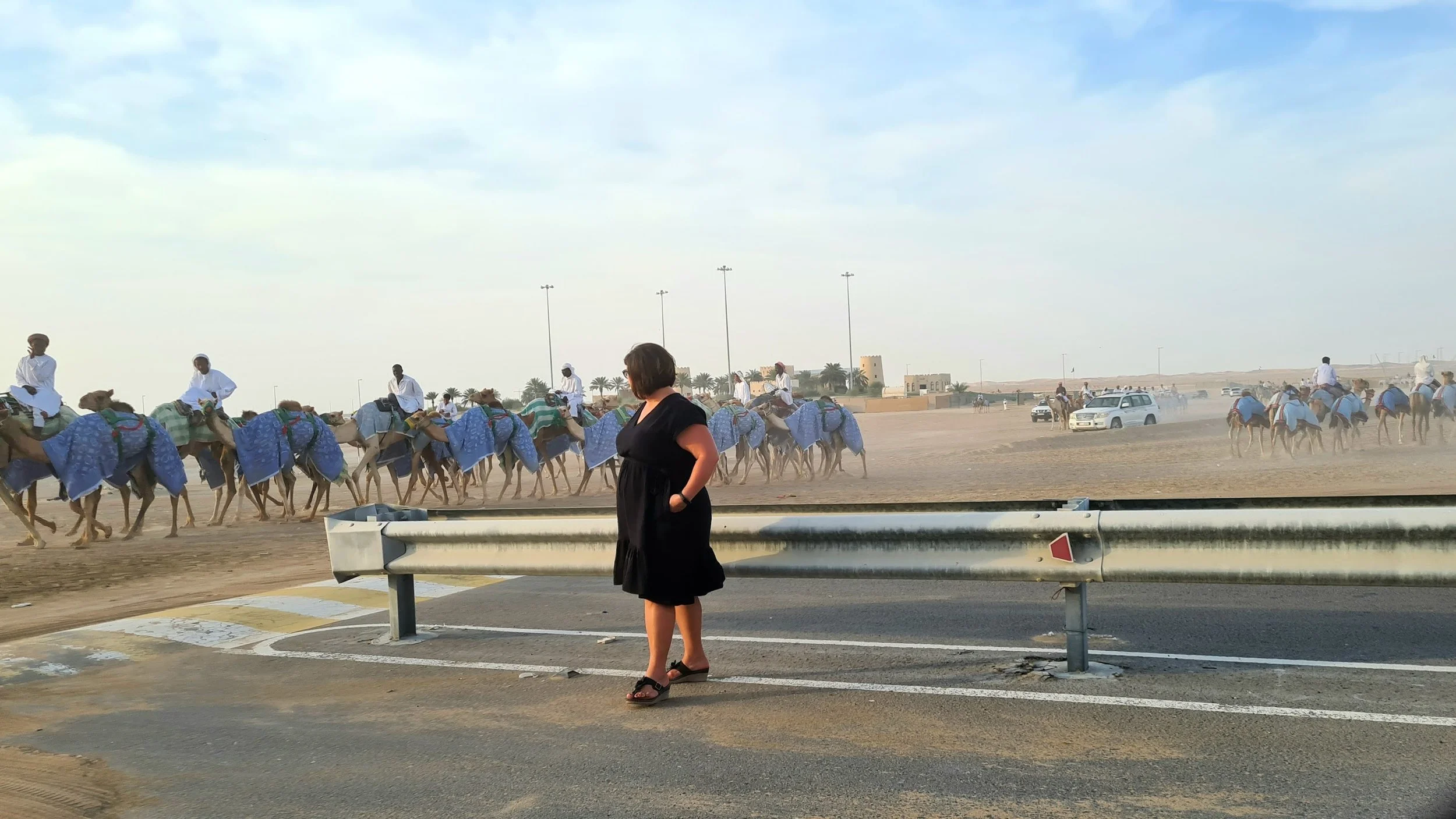
On Saturday, I suggested a half-hearted effort to drive into the desert and find the set of Dune II. But we opted to get shawarma instead. It was on the way back from this failed (but also successful mission–the shawarma was delicious) that we came upon an ocean of camels on the roads near the track. Hundreds of camels, as far as the eye could see, crossing each way, but moving in orderly lines under the guidance of their handlers. I noted the handlers. Someone goofier than me might describe them as “rugged” or “worn by the sun.” But I couldn’t stop laughing that each of them–all in their 20s–had their eyes glued to their phones while they glided about on the backs of the camels. It was a mix of the timeless and the modern, so rich we had to pull over and take the whole thing in. We may have failed to catch a race (again) and to find Zendaya (we didn’t try that hard) but we made a memory for a lifetime.

I think we will make one more stab at catching a race, later this fall in Al Ain. Wish us luck.  

In Personal, Travel Tags Camels

Taking Unneeded Anxiety Out of Assessment

June 16, 2022 Nathan Bowling
Distraught student

Don’t do this to your students | Photo by Andrea Piacquadio @ Pexels

The last few years have been fascinating in the teaching profession. In the depths of the Covid lockdowns, teachers were hailed by the public as heroes. I knew this would be fleeting and it wasn’t long before a “these lazy teachers need to get back to work” narrative took hold in the discourse. People went from lauding educators to calling us bums faster than you could say “​​severe acute respiratory syndrome coronavirus.” 

Then we reopened buildings, in some locales this went smoothly. In others there was chaos and nasty “will we or won’t we?” fights over mask mandates. I remember watching this video from Florida and saying to myself “man, it can’t get much worse than this.” Boy, was I wrong.

Well, this was our year to “return to normal.” Let’s recap this school year: There is a contrived moral panic over what to share about race in classrooms, leading to teacher speech codes. We have teachers being accused of “grooming” for validating the existence of LGBTQ+ students and colleagues in our midst. More recently, we experienced another senseless, preventable mass shooting that took the lives of nineteen children and two educators. 

If I’m being honest, at the start of this year, I cringed every time I heard an adult talk about wanting to “get back to normal.” Beyond the building closures, reopening fights, and bickering adult nonsense described above, there was the massive loss of life in our society. 1,033,830 of our fellow Americans died of Covid (as of June 7, 2022). This included my own father, the parents of many of my colleagues, and most importantly (for our discussion here) the parents and grandparents of hundreds of thousands of students in our classrooms and playgrounds. There are students still quietly mourning. There is collective grief and trauma walking our hallways. There are a lot of kids who aren’t okay.

Knowing this has led me to examine some of my pedagogical routines and practices. I am a veteran teacher: sixteen years in the classroom and in my third year at my current school. I’ve taught one of my courses for a decade; I have a supportive admin team that doesn’t micromanage my work. I have room to experiment. So I set about this year rethinking my assessment practices and how to reduce the anxiety the assessment process gives my students. 

First, I increased the number of summative assessments in my class by chopping up larger tasks into more manageable pieces. This allowed me to give students more targeted feedback and gave me a more clear picture of gaps in their understanding. Rather than saying “Hey [Student X], it seems you don’t understand [Y-broad concept], I am now able to provide students with specific knowledge and skill areas where they have room for growth: “Hey [Student Y], on the assessment you struggled with [Z-narrow knowledge or skill].” This shift gave me more targeted information for my post-assessment debriefs and reteaching. 

In addition, I escalated my use of whole-class reflections immediately after each assessment. Each time we completed a summative task I asked students to discuss these two questions: 

  1. To what extent was this task aligned to our instruction? 

  2. To what extent was this task a fair measure of our in-class learning?

This was followed by a whole-class conversation about the task. Doing this helped accomplish two goals: It reinforced the importance of the formative process for students. They understand that my assessments aren’t generated by me throwing darts at a dart board. They follow a logical sequence and are carefully aligned to the skills and concepts we practiced in class. Secondly, it reduced the desire for students to engage in stress-inducing, last-minute cramming rituals. The assessment is the logical end goal of the path we have walked throughout the sequence of previous classes. They understood that if they had done their jobs along the way, the assessments would largely take care of themselves. 

Lastly, I stopped putting scores on papers, only offering narrative feedback. The scores are posted in our online grade system (this is a dragon I am yet to slay), but I don’t put them on their papers. Additionally, I don’t publish scores until we have collectively debriefed the assessment. This means the conversations we have after a task is returned aren’t about scores, which can bring added anxiety but, they're about learning, which is supposed to be the whole point of school. 

The results. Students definitely appreciated having more summative assessments, more opportunities to “demonstrate proficiency” (our school's assessment language for “meeting standard”). Notably, there was less anxiety on and around assessment days and more in-class conversations about actual learning, rather than scores, afterward. The first time I passed papers back without scores they kept flipping the papers over thinking I must have forgotten or expecting them to magically appear. I then explained my process and told them to take some time to read (and listen to the feedback, thanks to the Mote app). As they did, heads started to nod around the room and several people mouthed “yeah, this makes sense.” Most hilariously, my “was this assessment aligned to our instruction?” became a bit of a meme in our class. Students would come in and give movie critic-style reviews of other assessments they were receiving, rating them on their aligned-ness. A student would walk in and announce “Oh boy, that [insert subject] assessment was definitely not aligned to the instruction. Two stars,  good luck folks.” Then the whole room would bust up laughing. 

Listen, none of this is revolutionary. Perhaps you are doing some or all of these already, but these shifts have changed the way my students talk about their assessments. Instead of focusing on a score, they focus on the feedback. On occasions, when they get score obsessed because there is always one (or a few), I can redirect them to the focus on learning. In 2022, I feel like life is hard enough for students, so why should my assessment practices add more stress?

This post originally appeared on the Teachers Going Gradeless Blog

Comment

The Hardest Summer of My Life (or Why Elder Care is No Joke and You Should Learn from Me)

August 8, 2021 Nathan Bowling
Mom and I when I made a surprise trip home in November 2019

Mom and I when I made a surprise trip home in November 2019

On the afternoon of June 10th, when my phone rang at 2:30pm and I saw it was my niece, I immediately knew it was bad news. My niece and I text a lot. But a call out of the blue at 2:30 Arabian Gulf Time is a call at 1:30am back home, there’s no way that’s good news.  

Earlier that evening, my mom, who is eighty and more important to me than I can describe, was critically injured in a car accident. At first details were sketchy, but as the situation became more clear, I became more alarmed. My wife and I were scheduled to fly home from Abu Dhabi on the twentieth. When I got the news, I changed my ticket to the sixteenth, the last day of school. When I got the details, I moved it to the next morning. 

A driver, under the influence, had plowed into a car mom was riding in at approximately 50 mph. They hit the car with so much force that both cars rolled over and laid on opposite sides of the intersection. Mom had a broken neck, several shattered ribs, and had to be intubated. She had abrasions on her face and a massive contusion on her head like a defeated boxer. Because of the damage to her ribs and chest she was unable to breathe on her own and was in a medically induced coma. She remained in this state for sixteen days. In that time, doctors performed surgery on her neck, fusing six fractured discs. They performed a procedure called rib plating that looks like something out of a Wolverine comic. 

Throughout the pandemic, I have marveled at the doctors and nurses in ICUs. What they’ve seen and the secondary trauma they experience are difficult to imagine. But after seeing them care for mom, I am eternally grateful. They are the best of us. Not all jobs in hospitals pay well, some of the people who have the most intimate contact with our loved ones are shamefully underpaid. But every hospital worker is a hero to me. They face death and grieving, sometimes angry families. The staff at Tacoma General was tremendous. At one point, a doctor told me “we need a miracle.” I started crying and we prayed together. That’s actually not true: she prayed, while I just sobbed. It's been a rough two years for the family. I lost my dad last summer to Covid. On the anniversary of his death, July 27, I had a full on panic attack about losing them both.

But she's alive. Mom’s recovery has been slow, due to her age. Her mobility will be limited going forward. She's still in the hospital, but she’s on the road back. I haven’t talked about this situation online until now, because I couldn’t figure out how to do so. I don’t want a pity party; I don’t want to respond to 100 messages; I don’t want every in-person conversation to be a recapping of a situation that has led me to tears more days than it hasn't. But this summer, I learned some very real lessons about dealing with aging parents. 

These are things you've probably heard before, but like me, you didn't listen. Like the old saying goes, a hard head makes a soft behind, well, my behind is worn out. Learn from me:

  1. We are all going to face mobility issues as we age. Multi-story houses are for the young. If you are a working adult and know you will be supporting an aging parent one day, a rambler or ranch style house is the way to go. Mom is not going to be able to ascend or descend stairs going forward, so we'll be undertaking a remodel of her house to move her bedroom to the ground floor and my older brother will be moving in and responsible for her care. 

  2. If you don't have a power-of-attorney in place for your parents, you are setting yourself up for a parade of headaches. I have a pile of angry notices from a credit union over a late car payment because we could not access mom's bank accounts until just last week, nearly two months after the accident.

  3. Have conversations with your loved ones about care decisions and what they would prefer. At one point my niece said "Grandma said she wanted X" and my brother and I both exclaimed "That's not what she told us!" We should have had these conversations, as a family, before now. It's even better if these things are in writing. 

  4. Speaking of, if you have documents in writing, like a will, make sure everyone knows where they are. There's no point in making the documents if no one knows where the hell they are when it's time and sooner than later it will be time.

Mom was discharged from the ICU in mid-July. She was transferred to a specialty facility in Seattle where she's continuing her recovery. Sitting by a hospital bed, reading to her, sharing church gossip, and commuting on the 594 bus and Sounder train to the care facility has been my full-time job this summer. 

Thankfully, mom's condition is stable and improving. We have a care plan in place for her. The person who hit her goes to trial for vehicular assault in November. And I know for sure I’ll be home for the holidays. In the interval, keep her in your prayers and learn from our experience.


← Newer Posts Older Posts →

POWERED BY SQUARESPACE