• Home
  • Blog
  • Media
  • Contact Me
  • Newsletter
  • Bowlings Abroad
  • Nerd Farmer Podcast
  • Teaching Civil Liberties
  • Supporting Undocumented Students
Menu

Nate Bowling: American Teacher Abroad

Street Address
City, State, Zip
Phone Number

Your Custom Text Here

Nate Bowling: American Teacher Abroad

  • Home
  • Blog
  • Media
  • Contact Me
  • Newsletter
  • Bowlings Abroad
  • Nerd Farmer Podcast
  • Teaching Civil Liberties
  • Supporting Undocumented Students

A Three Year Trip from Shanghai to the Netherlands

January 28, 2023 Nathan Bowling

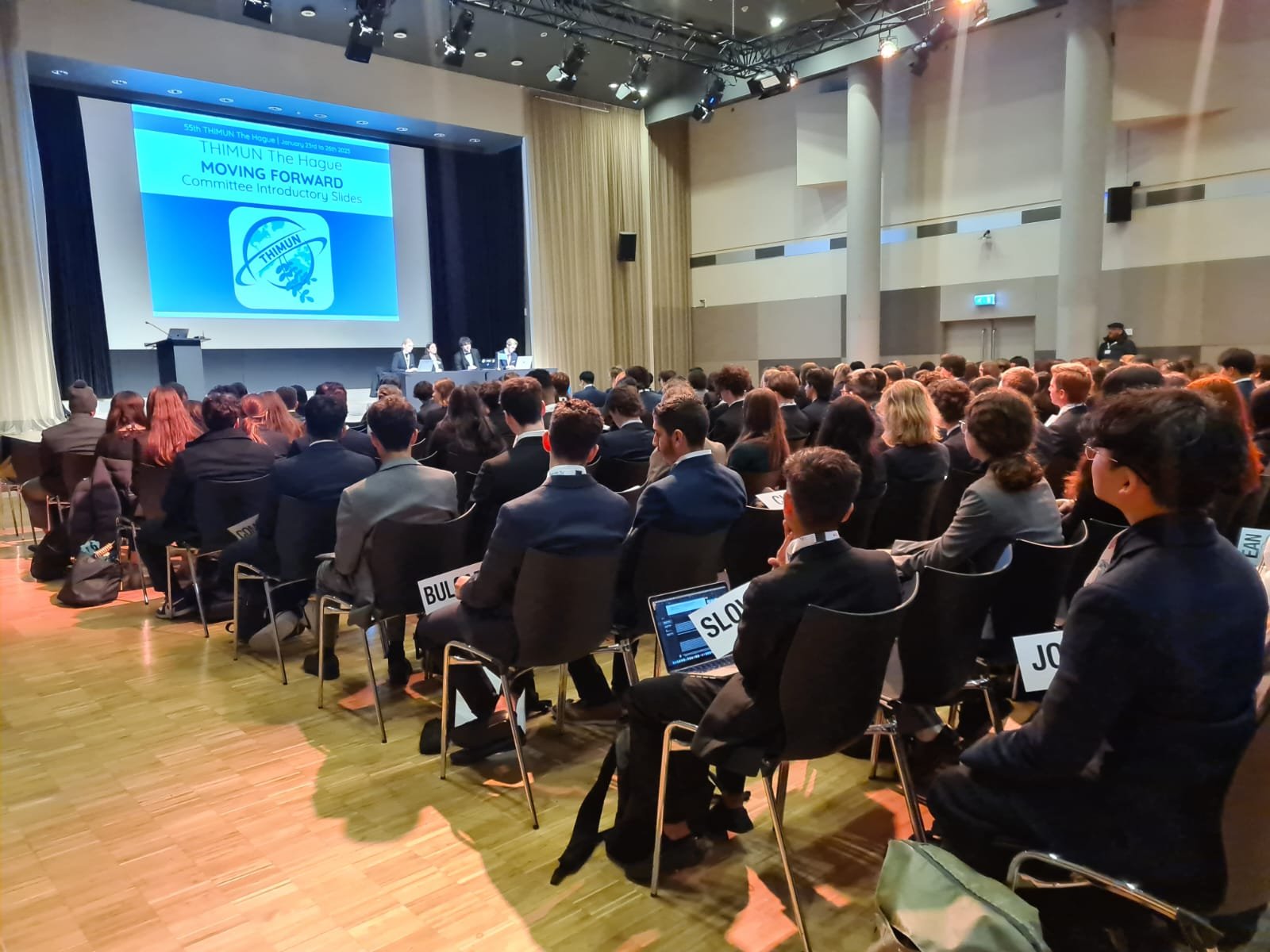
Delegates at THIMUN in one of the General Assembly sessions

We were nearly stranded  in China when the first wave of Covid lockdowns hit in January 2020. I was chaperoning a group of students in Shanghai at a Model UN Conference. At the conclusion of the four days of resolution writing and debate, we flew home on January 21. We just made it out. I wrote this piece on January 23,  after getting back to Abu Dhabi, praising Shanghai dumplings and talking smack about high school debate. Unbeknownst to any of us, that same day the first Covid lockdowns began in Wuhan. Within a few weeks everything everywhere had closed. You know the rest of that story. 
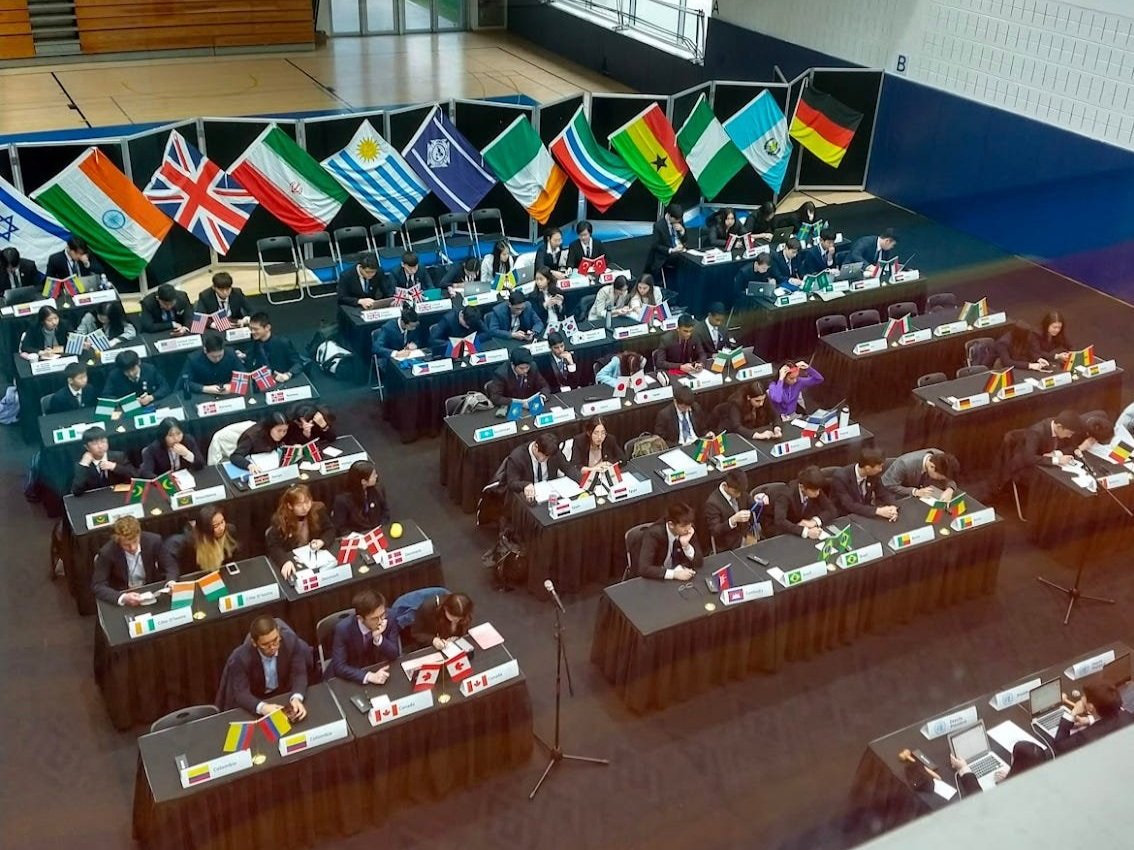
The ECOSOC Committee (United Nations Economic and Social Council) in January 2020 at Concordia International School’s CISMUN Conference

Since the pandemic began, my students have been doing their Model United Nations Conferences and debates online. That doesn't sound like a big deal but it really, really is. Imagine going through a full day of school—sometimes in person, often online—then logging on to debate a policy paper you wrote on refugee resettlement with kids in Karachi, Singapore and Seoul, deep into the evening hours. They’re digital natives but I wouldn’t wish that much screen time on  my enemies. It was an insane ask of them and one they met.

Throughout the three year pandemic period, our club naturally shrank. But the students who remain are deeply committed and now seasoned delegates. So, from the moment the UAE government announced they were lifting all Covid restrictions on November 6, students in our Model UN Club have been full speed ahead to the THIMUN Conference in the Hague. The conference is massive: 3,200 delegates and advisors from over 200 schools.  The conference was held at the World Forum. The building is on a sprawling campus, bracketed by the UN International Criminal Tribunal, the Organisation for the Prohibition of Chemical Weapons, and the Europol HQ.  During the conference, I spent hours circulating to the various committees where my students were debating. In the times between, I got to chop it up with teachers from London, Rome,  Cairo, Tashkent, Athens, and Kaiserslautern. 
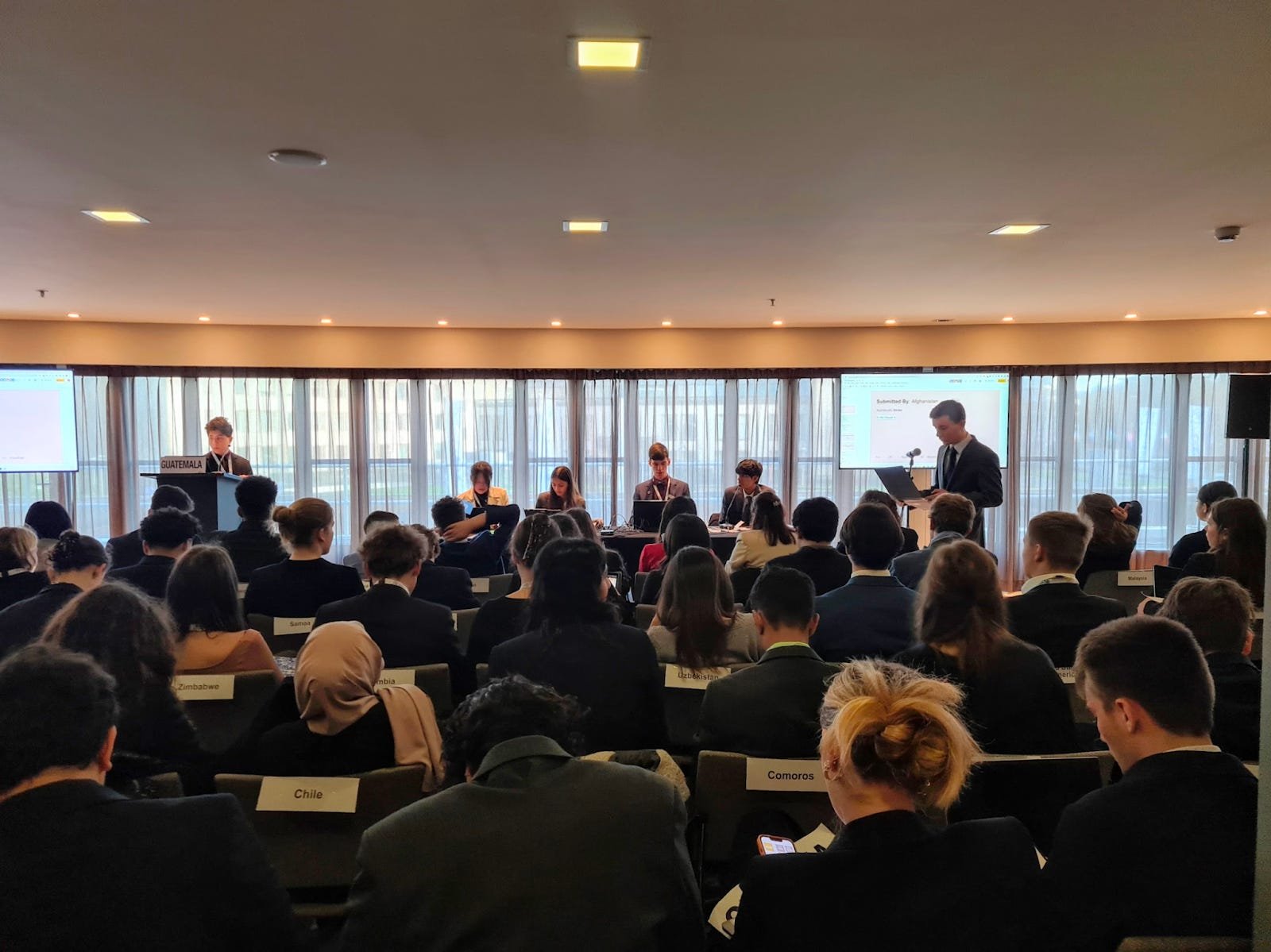
The delegates in Environment Commission I, on the last day of debate

Longtime readers know that I am short (betting against) the near-term future, but long (betting for) the kids and their longer-term future. Each time I walked into the sessions in the Hague (with the exception of the chaos that went down in General Assembly I), I was reminded of why my sentiments about both—the near-future and long-term future—are so stark. It’s heartening to see students from all over the world  engaging in complex arguments, many in their second (or third or fourth languages) about disarmament, territorial disputes, human rights, environmental conservation, and myriad other topics. At the same time, I couldn’t help contrasting these delegates and their nimble thinking and commitment to making the best possible policy to the absolute Muppet Show of politics back home. Literally, we’d be better served by having one hundred randomly selected delegates from a conference like this sitting in the US Senate than the collection of fossilized culture warriors who occupy the North Wing of the US Capitol. I would trade Chuck Grassley for a random Jordanian teenager any day of the week.

This was a great experience for the students and for me. I got to spend some time wandering the streets of the Hague and taking in some of the sights. Although Hope and I have tramped our way around Europe, I’ve never been to the Netherlands. All the stereotypes about the Dutch speaking perfect English and being impervious to cold weather are spot on. Three plus years in the Gulf have softened me to how brutal a ten minute walk in two degree weather can be, while these fools were dining al fresco with their toddlers. 

We have one more conference scheduled for this year. But it's almost a home game, a smaller conference (800 delegates) at Dubai International Academy in the spring. It feels good to know that our next conference experience will be in a few months rather than years.
In Education Tags MUN, The Hague, THIMUN

Another Take on that Silly Chat Bot (or Death to the High School Essay)

January 22, 2023 Nathan Bowling
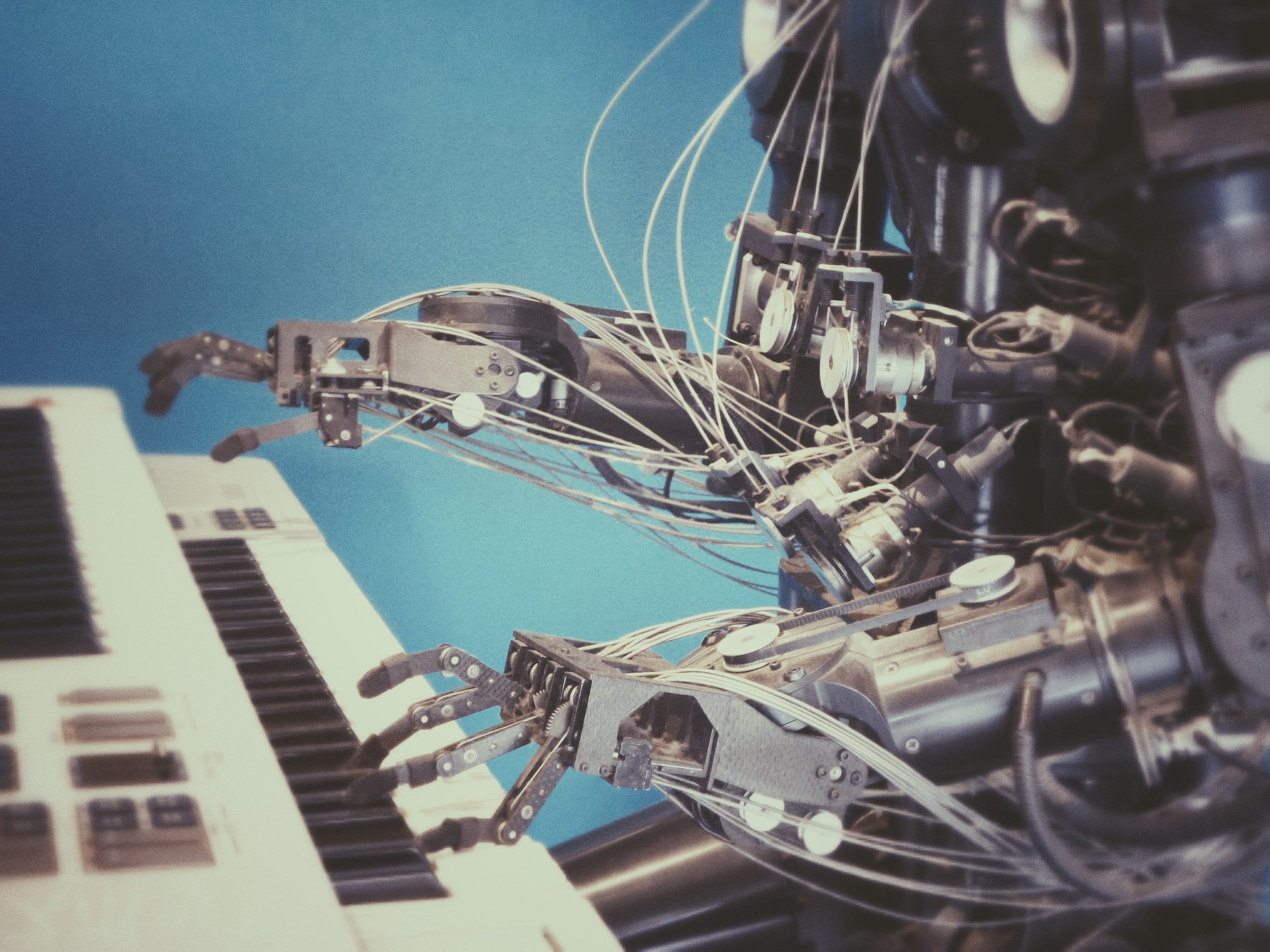
A creepy image of a robot plating a keyboard.

I’m not opposed to new technology. Hell, I love a new gadget as much as the next guy. But we need to pump the brakes and have some collective conversations about the mainstreaming of AI.

I hold heterodox views on teaching writing. In brief, the way we teach writing in K-12 largely prepares students for further academia and not actual life. For example, I don’t use MLA (or APA) citations in my everyday life; you likely don’t either. I haven’t used them since grad school. When I want to cite a source, I use a hyperlink, occasionally a footnote.

When it comes to writing tasks, many teachers are obsessed with page and word counts. I try me best to avoid them. When I assign a task to a student, I tell them how many ideas or arguments they need to present, not how much to write. If a student can make a coherent argument for the abolition of the filibuster in the Senate, using two arguments, some evidence, and a counterclaim in 800 words, great! Oh, you need 1800 words? Fine. In the end, I care more about the ideas my students are interrogating than about the volume of writing they produce.

Writing instruction should ideally center on real-life use cases. They need opportunities to play with complex ideas rather than writing fewer, longer high-stakes pieces. I’ve been paid to write. Definitionally, I am a professional writer (don’t laugh). In all the occasions I have been paid to write something, it’s never been much more than 1000 words. If that’s good enough for Slate, it should be good enough for an IB/AP/A-Level comp class.

Now before you start erecting guillotines… Yes, students need to write and revise more often. Yes, they need to be taught to write for specific purposes and contexts (a wedding toast, a resume, a cover letter). But if a high school student can craft a coherent, thoughtful 1000 word essay, they’re in good shape. More isn’t better, it’s just more.

Lastly, almost all the writing my students do in class is hand-written, on-demand. I give them a prompt and some stimulus (a map, a data set, a passage from a primary source) and they go to town for the period. But in each class I teach, there’s usually also one longer, more formal essay each year where students are required to demonstrate more traditional essay skills. I really don’t enjoy reading or grading them, but I understand the exercise has some value.

The preceding was my philosophy on writing until last week when that silly chat bot rolled into room 157.

Real talk, I am never assigning another out of class essay as long as I live. Ain’t no way in hell I’m gonna throw away my evenings and Sunday afternoons trying to figure out if the essay I am reading is Charlie’s or a chatbot. Nope, nein, nada—that is for suckers. I ain’t no sucka.

But it’s bigger than that. The emergence of AI created content onto the mainstream of our society with essentially no public debate or government regulation is incredibly problematic. Even worse, Open AI, the creator of ChatGPT (this is the only time I will use the name of the bot in question because every time you mention them you’re advertising for them), was co-founded by the problematic richest man on the planet, Elon Musk. Even worse squared, another co-founder, Sam Altman, was behind a massive crypto scam, Worldcoin. It promised to provide a form of UBI by collecting iris scans from half a million people in developing states in exchange for a crypto token that now trades at $0.02221. I am not making this up—this is possibly the worst idea ever, carried out by the worst people possible.

To be clear:

I want nothing to do with it.

Burn it with fire.

Let it fall forever in the Mines of Moria with the Balrog that killed Gandalf.

If you think I am being extreme here, that’s okay. Most people I talk to about this topic say the same. I got called a luddite for this take on my own podcast Friday night.

Here’s the thing. Philosophically, when I am presented with a moral question, I assume the “most likely, worst case scenario” and work backwards in crafting my personal response and preferred public policy outcome. For example, should we arm teachers? Well, do you want a racist Karen teacher that “fears for her life” shooting a Black middle schooler? No? Me either. So that’s a rubbish idea. Next, do we want the coverage of the upcoming election to be a torrent of partisan AI crafted propaganda and foreign-funded AI disinformation? If your answer is no (and unless you’re a psycho or a libertarian tecno-triumphalist, the answer should be no), we have to ask ourselves how do we prevent this dystopian hellscape scenario from taking place?

That’s where my conversations about mainstreaming AI start. Some of these pieces coming out from teachers about how they plan to integrate the bots in their practice are the most naive non-sense I’ve read in my whole life. Obviously, AI and machine learning are coming and have a place in our future. But do we have to let some of the worst people on the planet implement it with literally no regulatory checks, foresight, and the absence of an inclusive societal discourse? That’s just silly but not as silly as assigning the same tired essay prompts in 2023.

In Education, Society Tags AI, chatbot

In Defense of Gatekeepers and Screaming Loudly at Bigots

January 14, 2023 Nathan Bowling

The next time someone complains to me about free speech, I’m just gonna yell “Stop!”

Sometimes I think the internet was a mistake. 

On its surface, the internet is a very silly concept. The idea that I, a curmudgeonly high school teacher, can have an audience the size of a newspaper or TV station in a mid-sized city is insane. I don’t think anyone deserves an unmediated channel to the entirety of humanity. The negative incentives and temptations are too enticing. Human brains and our ethical development as a species are too primitive for that much power. I have thought this for a while but ignored my inner-monologue for years.

I once had a full-blown panic attack and had to be talked down by a friend, when I saw that some ungodly number of people were viewing my tweets on a monthly basis. I didn’t take Twitter seriously—I still don’t. To me, it’s a glorified group chat, (with an audience). I often had to restrain myself (sometimes unsuccessfully) from making fart jokes. I always thought the idea that my tweets were generating interview requests from NPR and speaking invitations to be preposterous.  A sizable percentage of my tweets had typos. It became a running joke in my house, with my friend group, and the name of the new newsletter. I decided to walk away from Twitter (for the second time) on Halloween: Takes & Typos was born in November.  I think I am better for it and I am glad you’re along for the ride.

In the 90s when the internet hit the mainstream, there were a lot of breathless opinion pieces celebrating the “rise of the citizen journalists,” “the democratization of media,” and “the death of gatekeepers.” Each of those has yielded mixed, at best, results. Many of the “citizen journalists" are cranks, conspiracy theorists, or worse. The “democratization of media” has given scammers, propagandists, and fabulists massive platforms to grift or “monetize” their followers. “The death of gatekeepers” is similarly going poorly. The intervening thirty years have shown us that we need better gatekeepers—not their abolition. Gatekeepers kept schmucks and fascists on the fringes. What we needed in the 90s was someone to send Thomas Friedman or Ruth Marcus out to pasture, but what we got was Alex Jones’s InfoWars and anti-vaxx crunchy mommy blogs.

Another way the internet is a mistake is its ability to elevate bad faith arguments into the political mainstream. There is currently an ongoing, disingenuous public spat over the “free speech crisis.” Possibly the most tedious salvo in this discourse was  this unfortunate letter in Harper’s crying about the current “stifling atmosphere” regarding speech. Ask yourself, in the year of our Lord, two thousand and twenty-three, do you think people being unable to share their (terrible) opinions and beliefs is really a major societal issue? Do you feel censored or silenced in your life? That doesn't pass the smell test for me. 

The people crying about speech are what I term opinion elites: people previously able to opine on newspaper opinion pages and in university lecture halls, without any real rejoinder. But an upshot of the aforementioned “democratization of media” is that now when they publish nonsense takes (pick your poison: race science, transphobic TERF-ery, anti-immigration sentiments, or other reactionary apologetics), they get an earful from people they perceive as below them. They are unaccustomed to being told “sir/ma’am, your takes are abhorrent and here’s why…” en masse. This is the core of the speech crisis. We have a cadre of elites conflating people telling them "I don't like you or what you're saying" with "you don't have the right to say it." Speech is a two way street. Yelling “shut up you noxious bigot, you’re not welcome in this space” is impolite. But the right to do so is as sacred as the right to pen cornball columns in the paper of record.

In Personal, Society Tags Twitter, Free Speech
← Newer Posts Older Posts →

POWERED BY SQUARESPACE