• Home
  • Blog
  • Media
  • Contact Me
  • Newsletter
  • Bowlings Abroad
  • Nerd Farmer Podcast
  • Teaching Civil Liberties
  • Supporting Undocumented Students
Menu

Nate Bowling: American Teacher Abroad

Street Address
City, State, Zip
Phone Number

Your Custom Text Here

Nate Bowling: American Teacher Abroad

  • Home
  • Blog
  • Media
  • Contact Me
  • Newsletter
  • Bowlings Abroad
  • Nerd Farmer Podcast
  • Teaching Civil Liberties
  • Supporting Undocumented Students

Three Nights in the Land of Fire - A Travelogue

February 19, 2023 Nathan Bowling

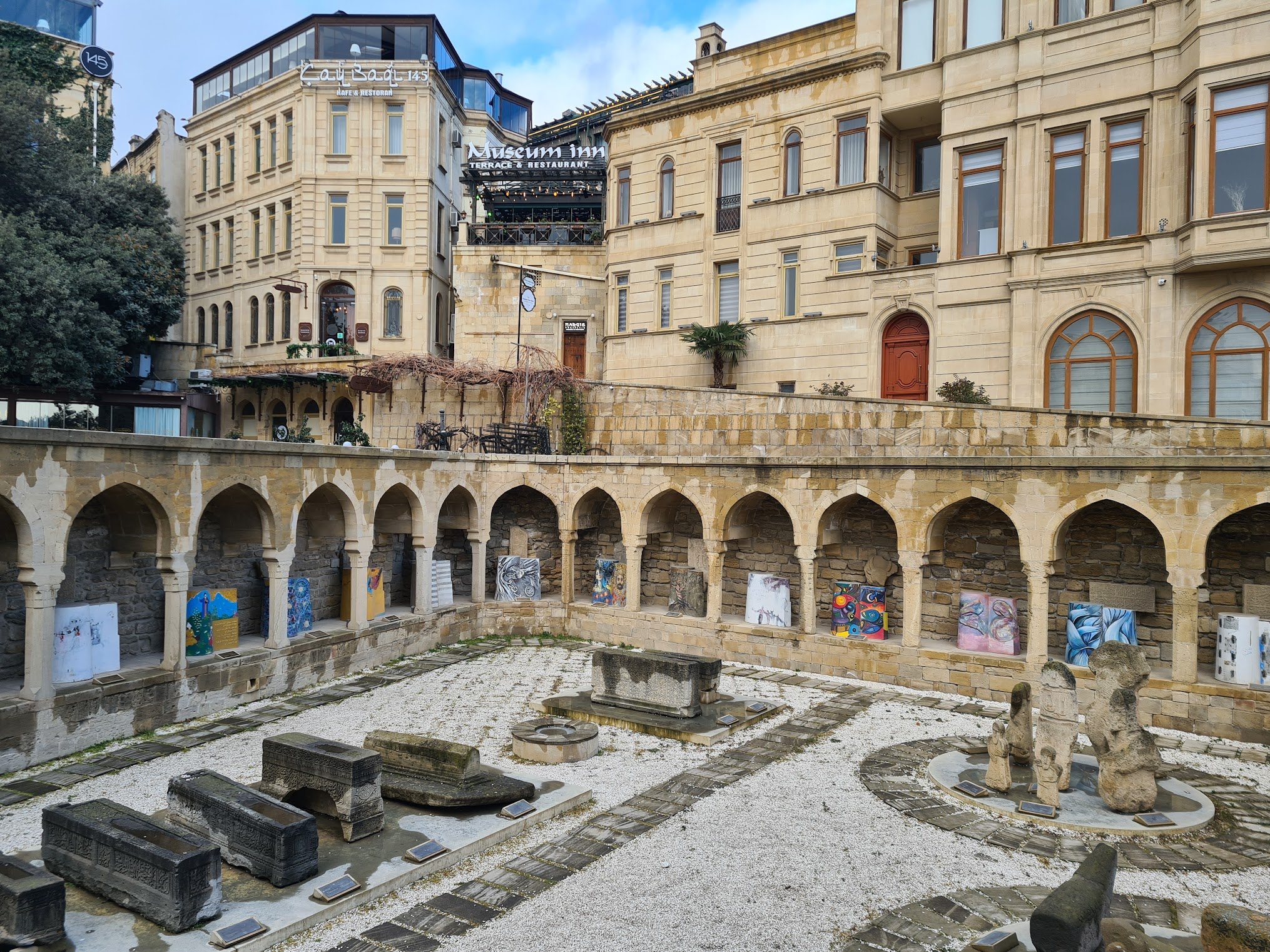
February in Abu Dhabi means temps in the 80s, but February in the land of fire means winds strong enough to knock you off balance and evening lows below freezing. Walking across an open area, like a plaza or square, elicited several “okay, we can do this” intra-group pep talks as we traversed old town. This is my second recent trip into “real winter.” The trip to the Hague was a good dress rehearsal because those Azeri gusts don't play. 

This plaza features wonderful dining and is an absolute wind-tunnel after dark

The Skinny on Azerbaijan - With a population of four million people, Baku, the capital, is as beautiful as any city I've visited. Its legacy as a major stop on the Silk Road gives it a deeply historical feel, like Xi'an or Istanbul. Two vestiges of the Silk Road come together in Azerbaijan: the trade routes brought Islam further to the east and brought dumplings from China westward into Slavic and Turkic cuisine. 

The country is 96% Muslim but due to the imposed atheism of the Soviet era, the government and broad culture are secular. All the mosques we saw in the city were built in the classical style, but we learned they were of recent vintage, mostly built after the collapse of the USSR. Like we saw in Georgia, the architecture fell into three main buckets: ancient AF (classical), Soviet AF (brutalist), or futuristic AF.

Maiden Tower.jpeg
1.jpeg
2.jpeg

Azerbaijan was on the business end of several historical  conquests, having previously been a part of the Persian Empire, Russian Empire, and Soviet Union. The people are Turkic, like the people of Central Asia, Turkey, and the Uighers in China’s Xinjiang Province. But I noted they don't make the Turkic/Turkish distinction we make in English—our guides repeatedly called their countrymen "Turkish people." To that end, the Turkish flag is often displayed alongside the Azeri flag in the country. I've read elsewhere that Azerbaijan is culturally and politically Turkey's little brother. That largely checked out but leaves out the Soviet/Russian Empire thing. 

Speaking of Russia, their relationship with Azerbaijan is complex. Azeris share a border with their colonizers. Students in primary school are taught the language and Russian is widely spoken by Azeris in the streets. Russian tourists fill the historical sites. But Azeris are apprehensive about their relationship with their northern neighbors. I heard the phrase “we have to keep Russia happy” no fewer than six times when discussing events in the Caucasus Region.

The Heydar Aliyev Center, the Presidential Museum, and center for explaining the Azeri side of their conflict with Armenia

Generally, I was struck talking to Azeris by their sense of pride in their country, their Islamic faith, and the ways in which the government provides for the people (from their oil & gas profits). Azerbaijan is a post-communist state but dodged the neoliberal shock doctrine and IMF structural adjustment bullet, that stripped many states of generous public benefits over the last thirty years. Put differently, the legacy of communism there is a fairly generous social welfare system, rather than a stripped down neoliberal shell of a state. They provide well for their people, especially for a country with a per capita GDP that ranks between Barbados and Albania:

  • Azeri workers get roughly a month of paid time off each year

  • Public university tuition is free for students who are academy qualified based on national exams 

  • Tuition is also free (public or private) for people seeking employment in essential careers: doctors, pilots, etc.

  • They enjoy more or less zero out of pocket health care for basic and preventative care services

  • Typical rents run between $200 to $300/per month in the city

  • The government pays a subsidy to new parents, a one time baby bonus 

  • They pay roughly $30 per month for utilities and the country subsidizes energy bills in the winter for all citizens 

That’s quite a list. 

Places that have less than the US seem to offer their citizens more but we somehow call them developing states.  

In Travel Tags Azerbaijan

The Canaries are Dead and No One Wants to Go into the Mine

February 12, 2023 Nathan Bowling

Yet another colleague from back home reached out to let me know they're listing me as a reference this week. We're losing great teachers at a distressing rate.

Coming out of grad school, I considered various options for where to begin my teaching career. I ended up working in my hometown of Tacoma, remaining there for thirteen years before moving overseas. But somewhere in the multiverse, there are alternate Nates that followed other paths. 

I completed my masters in 2006. The seminal news event of my two years in grad school was the failed government response to Hurricane Katrina (just nudging out our failures in Iraq). Millions of us watched as the citizens of New Orleans were abandoned by every level of government and left to fend for themselves in agony. The hurricane was a form of ethnic cleansing, wiping out entire mostly Black neighborhoods, replaced largely by real estate speculators and their AirBnBs. In some ways, it feels like we’ve collectively memory-holed the largely preventable deaths of nearly 2000 people. We must “never forget” 9-11, but it seems we never remember Katrina. 

The hurricane did more than destroy much of New Orleans. It reshaped  neighboring urban centers as people were forced to resettle: 84,000 evacuees to Atlanta; 50,000 to Baton Rouge; and a staggering 150,000 to Houston. In late 2005, enrollment in Houston area schools swelled as families resettled from NOLA. I have family in the area and Houston ISD flung a wide net trying to hire teachers to meet the soaring need. I was offered a job but ended up not taking it. I’ve always kept an eye on news and events in Houston ISD. It’s February 2023 and they currently have 282 unfilled positions.  

Another option I considered was moving to Nevada. Vegas’ population has soared in my lifetime, from 438,000 in 1980 to 2.8 million people today. The footprint of the area has grown to match (see video below). Vegas’ schools have struggled to keep pace but in 2006, before the housing collapse, they, like Houston, were casting a wide net.

Clark County was more of a possibility for me than anything. As with Houston, I’ve kept tabs. They have a MAGA/Sarah Palin school board member, ​​Katie Williams. She ridicules teachers, is hostile toward immigrant families, and is a Covid denier. It’s February 2023 and there are currently 1,079  teacher, counselor, and nurse openings in Vegas. 

Because schools are run by each state, as each state sees fit, data reporting on the number of unfilled positions nationwide vary. But at least forty states and territories are reporting teacher shortages this year (left) and the numbers are far more grave when you look at STEM, world languages, ELL, and teachers serving students with special needs (right). But it is more complicated than that. The shortages have local twists and permutations. States and districts with lower pay and states with so-called “right-to-work laws,” offering fewer job protections, unshockingly have it worse. More affluent communities (and states that permit unionization) are seeing fewer shortages, meaning low-income students and students in flyover country are more likely to have a revolving door of subs, combined classes, or severely limited course offerings

Left - an image from ABC news showing states, in red, facing a teacher shortage (spoiler: most of the map is red). Right - An image from Yahoo!: Data on school staffing shortages by position and the reasons for the shortage (Again, lots of red here indicating a lack of applicants).

There are no reinforcements in the pipeline - Enrollment in teacher prep programs dropped by ⅓ between 2010 and 2018. I promise you the pandemic made this situation worse, not better. During the period when the country shifted to online schooling, much of the country showed teachers their behinds, and people rightfully left the profession in droves. Worsening all of this, teaching is more complicated than it was in the past. I am not a “history teacher.” I teach a college-level US government course, another college-level course comparing the systems of government in the UK, Iran, Mexico, China, Nigeria, and Russia, and a blended ninth grade course: a mish-mash of macro econ, international studies, world geography, and post-WWII world history standards. My job description isn’t atypical. Unless we deeply narrow course options or swell already crowded classes, there will not be enough capable people willing to be subjected to the vicissitudes of teaching in many US schools.  

Over the last decade there’s been a push to get more students into STEM classes and higher-level classes in the Humanities. That’s cool and all but what happens when no one shows up to teach because they have far better options? It feels like we’re about to find out.   

In Education, Society Tags Teacher Shortage, Teacher Prep

No, Michael—Your Book Actually Didn’t Need THAT Scene

February 5, 2023 Nathan Bowling

Michael Mann’s highly anticipated Heat 2 is a grave disappointment, if you care about women or have a soul

I have rarely been more frustrated by a book as much as I was by Michael Mann’s Heat 2. Mann’s 1995 classic, Heat, is in my movie Pantheon. For folks of my vintage—who like three hour heist films—it is the holy grail. There is no The Town, Den of Thieves, Triple 9, without Heat. Even the opening bank robbery in the Dark Knight is derived from Mann’s stylized downtown LA robbery scene (below). 

The film stars Robert De Niro, in his acting prime, as Neil McCauley, the leader of a gang of highly-disciplined bank robbers in Los Angeles. Heat came out one month after Scorsese’s Casino, giving De Niro among the best back-to-backs in cinema history. Mann’s cast is full of actors who later fell on hard times or are now too old or broken to reprise their roles: Val Kilmer before his throat cancer; Danny Trejo before he was Machete; Tom Sizemore before he lost his career to substance, prostitutes, cocaine, and sex abuse allegations; and Jon Voight before he went MAGA. In the film, McCauley’s gang is pursued by an out of control LAPD lieutenant named Vincent Hannah, played by an extremely over-the-top (to the point of parody) Al Pacino. Watch the clip below and tell me I’m wrong. 

Heat was the first time Pacino and De Diro appeared on screen together. For 90s movie heads it was like Messi and Mbappe lining up together for Paris Saint Germain. Their scenes were electric—Pacino a trigger happy lunatic with a crumbling life and marriage and De Niro his ever precise, cautious, and calculating prey. In our age of sequel culture a Heat sequel was inevitable. But in doing so, Mann was faced with a choice: recasting the iconic (and some disgraced) actors or using de-aging technology, like Scorsese had done with the Irishman. He opted for neither and decided to make the sequel a 470 page tome. When I heard that Mann was going to make a sequel, albeit a novel, I was ecstatic. The book functions as a prequel, looking at the lives of characters from the film and a sequel, telling the story of Val Kilmer’s character, Chris Shiherlis, who survived the climatic heist in the film but is gravely wounded in the firefight. 

As I have discussed in prior editions of the newsletter, as of late I am consuming copious of southern noir novels. If you’re unfamiliar with the genre, think about Timothy Oliphant's show Justified,  most Cormac McCarthy novels, or any number of the classics by Elmore Leonard. Obviously, Heat isn't Southern noir. It's set in LA but it follows all the tropes of the genre. Here’s the thing, maybe the book was amazing. I don’t know because I stopped reading it after a deeply unnecessary violent sexual assault. In the book, during a home invasion the “Big Bad” assaults an underaged girl. The assault was discussed in passing as it happened but then for God knows why, recounted in technicolor detail later in the text. It was gross. It was gratuitous. It ruined the book for me. 

There are better ways of building up a villainous character. I am deeply weary of seeing violence against women as a plot device to show that a guy who is clearly a scumbag is indeed a scumbag. Sexual assault isn’t a plot device. Stop treating violence against women as the new mustache twirling when you want to prove your “Big Bad” is bad. 

It’s gross and I’m over it. If authors and filmmakers can’t tell a story without a woman being victimized they can count me out.  

Exactly zero books and films have been improved by the inclusion of graphic depictions of sexual assault. It was lazy from Mann and ruined the entire book for me.

As an aside, I think it’s worth mentioning that I feel the exact same way about white characters casually using the n-word without consequence. This is a major reason I think Pulp Fiction, and most Tarantino films are unwatchable but that’s for another day.

In Society Tags Heat 2, Heist Films, Crime Novels
← Newer Posts Older Posts →

POWERED BY SQUARESPACE